Início Site Página 139

Do not burn after reading

Gustavo Nobrega
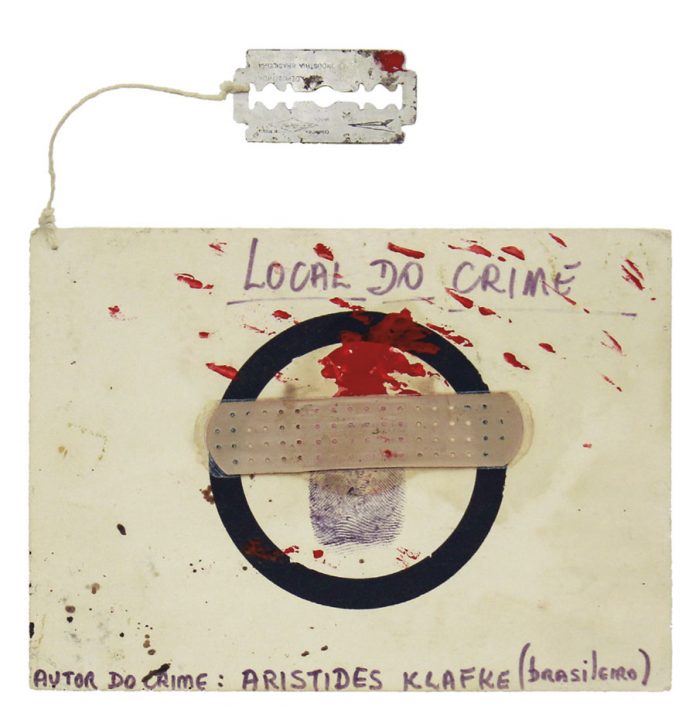
Cartão postal com intervenção de Aristides Klafke

With a quiet explosion from the 1950s, mail art has its pioneering roots in Ray Johnson and the New York Correspondance School, but also in manifestations such as Maciunas’ Fluxus. As the name delivers, it is a movement in which the art fits into an envelope or package that can be transported by mail. The possibilities are many and are not limited to letters or postcards. In Brazil, the movement began to take shape in the 60s.

Also known as postal art – a term that has fallen into disuse for reducing it to just one of the things used, the postcard – the movement consists of an exchange of information, networking and, at that time, a new medium for art. It can not be fooled by the fact that only works made out of paper were sent by mail, but also objects, tapes and videos, some even exchanging pieces of cloth from their own clothes. Artists sought ways to explore all five senses in what was sent to colleagues.

This movement “is no longer an” ism “, but rather the most viable output that existed for art in recent years and the reasons were simple: anti-bourgeois, anticomercial, anti-system, etc.”, wrote the artist Paulo Bruscky in published text in 1976 in the Jornal Letreiro, Federal University of Rio Grande do Norte. For him, one of the national exponents of mail art, the movement was essential when it came to breaking down barriers, whether for crossing physical boundaries when interconnecting artists from all corners of the planet or because there are “neither judgments nor awards to the works”.

With a marginal climate, since only those who receive and pass on have contact with the works, the mail art was closed to its agents, creating an intimate fluidity. In Brazil, the movement won a great homage at the São Paulo Biennial in 1981, where it had a space only to exhibit pieces produced in this flow, inviting artists from all over the world. The general curator of that edition was the critic Walter Zanini, who some years ago was dedicated to highlight the mail art in his lines and in his writings. In a 1977 text for the newspaper O Estado de São Paulo, he commented that one could not “deny that this activity triggers new communication and structural situations for artistic language”.

Involved with research on marginal groups, such as the Poema-Processo and the Nervo Óptico, which have been exhibited at the Superfície Gallery in recent years, gallery director Gustavo Nóbrega also devoted himself to researching mail art, creating an interest in encouraging its circulation in the market: “The idea is to create a look of collecting for this, in addition to publicizing and showing this production that was very important”.

During the last holiday of the end of the year, Nóbrega made a trip to the Northeast to visit workshops of artists who participated in those activities, he points to the region as the cradle of the movement’s vanguard. In São Paulo, he found very little material, “one, two or three envelopinhos”, there he found works in the mountains, “gigantic archives”. Courier art, which had even greater adherence by artists in Brazil around the 1970s, was not taken as commercial: “It was something even anti-market”, he says. The works were exchanged between the artists themselves, institutions and galleries did not integrate this substantially into their collections. Also, according to Gustavo, the artists themselves did not intend to sell these works.

Superfície Gallery represents Silva Silva, one of the most produced names in the mail art. It was in Falves’ studio that Gustavo found much of the work he brought with him to São Paulo. A priori, he intended to make an exhibition only with works of the movement, but thought it would be too much information. Some of the works that have gone through the research of Nóbrega will be in the next exhibition of the gallery, a panorama of the conceptual art of the 70’s, which will open at April 2nd. The exhibition will have a postal art by Avelino de Araújo, Paulo Bruscky, Edgar Antonio Vigo, Silva Silva and the Australian Pat Larter, among others. Materials of the collective Karimbada besides works of the exhibition Olho Mágico (1978) also will be included.

The place of art

Obra Sem título, de Anna Maria Maiolino, da série Vestigios, 2012

THE INCLINATION OF THE ARTISTS is increasing to connect with their surroundings and somehow to bring, in their work, a permanent reflection on the moment that they live.
It is nothing new, so much so that throughout history and in all times reality has pulled the ruptures and it was it that has boosted the construction of many artistic movements and iconic works in the History of Art.

This is the case of Picasso’s “Guernica”, which immortalized the bombardment of the Spanish city, Portinari’s canvases of immigrants, or the images of appreciation for US violence on Andy Warhol’s canvases, to cite even distant examples of his conceptions.
But if this has always been so. What has changed?

Over time, there have always been aesthetic and ethical choices, in the artist’s intention and in the reception of the viewer. When philosopher and art critic Richard Wollheim discusses whether works of art would be “anything but physical objects” in his book Art and its Objects, he states that “intention anticipates the vision of representation”.

What changes in each epoch, in my understanding, is how the artist tries to translate his/her inadequacy into his/her time. Artists are often explicitly inadequate and “artistic representation” seems to have been throughout human history the best way to “be in the world” and “find a standpoint”. On the edge of the abyss, in delirium or in denial, artists translate in one way or another something that tells us about them and about us.
However, this idea that seems to be more than internalized in the 21st century – after the rupture of the first avant-gardes a hundred years ago – seems to be questioned today, not by academic critique but by the “neoliberal man” who bets “on adequacy” in a world “shaped exclusively for him”, in a world in condominiums, surrounded by guarantees and certainties. A man who neither sees nor suffers from the degradation of the planet, with the increasing violence of increasing social inequality. A man who neither sees nor wants to know the other.

This man does not want to know about ART. He only chooses mirrors. He only values physical objects that preferably do not disturb him in any way and bring him peace of mind.
Here we talk about ART.

In Verbier, indigenous leader argues that art is not for cowards

James Capper, AERO CAB Test Run. Foto: Frederik Jacobovits

Can a highly elitist city, frequented basically by billionaires of the international circuit, where even the average Swiss citizen has no access, host a meeting of contemporary art?

The challenge is faced by the Verbier Art Summit (VAS), which had its third edition held on last February 2 and 3. The event was created by a group of residents and owners of chalets of the small town of three thousand inhabitants. What not lack there are famous millionaires such as the singer Barbra Streisand, the businessman Richard Branson, the collector Dakis Joannou and the Prince Andrew of England, who three years ago paid no less than R$ 65 million for a seven-bedroom cabin . Exaggeration gives the tone of the place, where a drink can cost R$ 25 thousand in the VIP parties of the city.

Since 2017, the VAS, led by the Dutch lawyer Anneliek Sijbrandij-Schachtschabel, consists of a two-day meeting hosted by a guest curator. The first was Beatrix Ruf, then director of the Stedelijk Museum, last year Daniel Birnbaum of the Museum of Modern Art in Stockholm, and now Jochen Volz, director of the Pinacoteca of the State of São Paulo.

For two days in the afternoons, the team he had chosen presented themselves in an auditorium with free entrance for enrollees, while in the morning in the sophisticated wooden chalets of the organizers, selected groups debated with the guests, meetings where journalists were not allowed. The exhibition of the movie The Midday Red was also included in the program, a movie by Swiss artist Tobias Madison in São Paulo, in collaboration with Grupo Mexa, which shocked the audience by portraying a very decadent city, and the test of mobile sculpture by the English artist James Capper in the midst of the ski resort.

With the theme We are many. Art, the political and multiple truths and a very radical team, among them, the Cuban artist Tania Bruguera, the Portuguese sociologist Boaventura de Souza Santos, the Brazilian indigenous leader Nadine Terena and the South African curator Gabi Ngcobo, Volz repositioned the elitist event in an elegant way. “I have been completely free to organize the tables, I have invited people that I greatly admire”, said Volz in Verbier. Some of the selected artists such as Bruguera, Grada Kilomba and Rirkrit Tiravanija will be part of the program of the Pinacoteca, now in 2019. On June 22, the book with all the lectures will be released at the Pinacoteca.

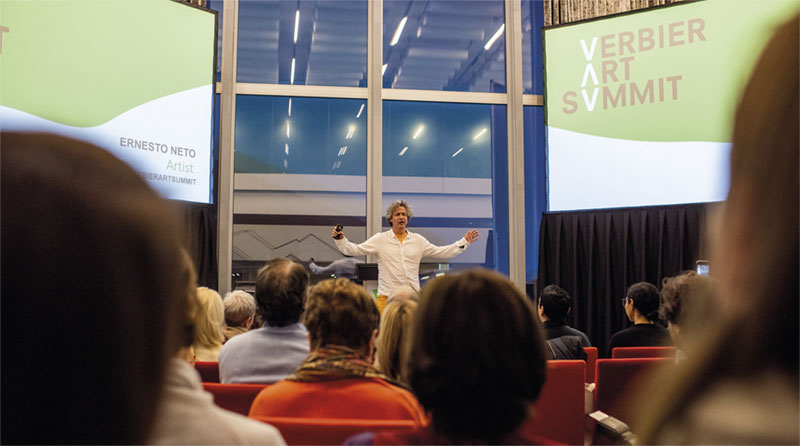
O artista brasileiro Ernesto Neto falou com o público sobre humanismo e interconexões. Foto: Alpimages Fleur Gerritsen

“We need to get down from the mountains to get to the mud”, said the Brazilian curator living in Brazil at the opening of the event, still under the impact of the Brumadinho dam burst just a few days before the Summit opened. It was a poetic and direct talk of how the art debate should not be restricted to a mere encounter but deserves to provoke concrete actions.

Following Volz’s departure, many of the guests sought to reconfigure the auditorium where the meeting took place, as to alter power structures. That was what she did in the first session Kilomba, who left the pedestal selected for the speakers, preferring to talk in a more informal way. “To unlearn is also to change spaces”, defined the Portuguese artist, who participated in the 32nd. Biennial of São Paulo in 2016. She presented scenes in Switzerland of her latest work, Illusions 2, a deconstruction of the Oedipus myth, created for the 10th Berlin Biennale last year.

The general tone followed in political reflections, as did Terena, who approached the threats to the 800 thousand Indians living in Brazil and began hes speech paraphrasing the president of the Sossego samba school: “Art is not for cowards”. For her, “the greatest art of indigenous people is to stay alive, it is resistance”.

Resistance was also the theme of Ngcobo’s talk about experiences of anti-apartheid movements in South Africa in the 1970’s, and how young artists are currently updating the issues of that period.

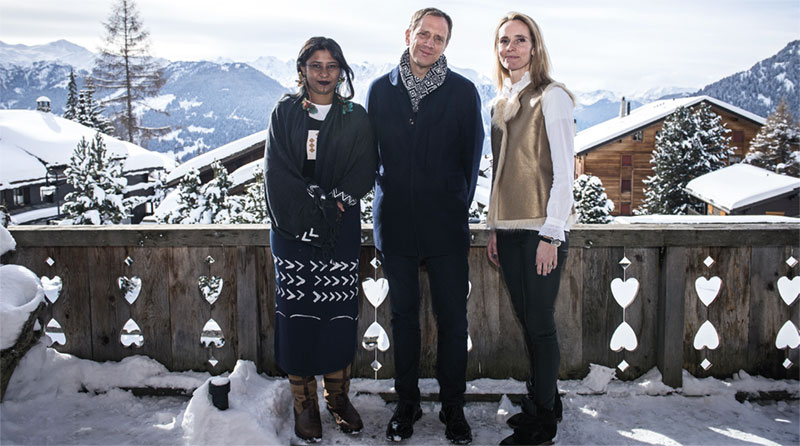
Jochen Volz com Naine Terena, à esquerda, e Anneliek Sijbrandij, à direita. Foto: Frederik Jacobovits

Santos, on the second day, in a speech that approached issues related to the defense of human rights, stated that he is participating in movements against the indiscriminate use of agrochemicals in Brazil. “There are many more people with cancer in the interior of São Paulo because of the poisons spread by agribusiness”, he provoked.

A frequent figure in Verbier, due to a music festival taking place in the city, the singer Barbara Hendricks, ambassador of Acnur (UN High Commissioner for Refugees) made a defense of art as an empowering element.

Finally, the Thai artist Tiravanija rethought the space of the meeting in a radical way: he descended to the audience and suggested that each one change the organization of the chairs, not being all facing the stage. On the gloom light, he asked the audience to watch his own breathing for ten minutes. In the end, he asked everyone to say something from the experiences of the two days in Verbier, generating some tension, after all it was a speaker who chose not to speak. There were those who, after such political contests, proposed that the group should have some concrete action, while others, like Gabi Ngcobo, instead of talking, played the song “We don’t need another hero”, famous in the voice of Tina Turner, which was the title of the Berlin Biennial, organized by her last year.

In this somewhat ironic environment, the silence of an artist like Tiravanija is a very coherent attitude with an event to discuss art in a city like Verbier. Art, in fact, is not for cowards.

13th Havana Biennial captures tensions voltages of the world

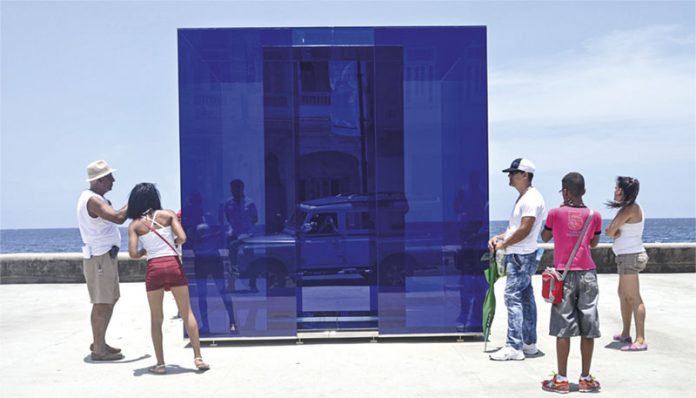
Raquel Valdes Camejo, Blue Cube, 2015. Foto: Leonor Amarante

With the theme “The Construction of Possible” and a broad speech, in tune with the socio-political-environmental concerns of the moment, the 13th Havana Biennial opens its doors on April 12 with an evolutionary version of its work over the years. It includes thematic lines related to architecture, the city and its surroundings, ecology and themes of gender and migration. One of the novelties of this edition is that it extends to other cities of the Island: Pinar del Río, Matanzas, Cienfuegos, Sancti Spíritus and Camagüey.

The Biennial, as a strategy, will investigate the perception of the present world, poetic procedures and nature that involve memory, society, history, belonging, a living topography taking into account “the conditions of a world that has intensified nuclear threats and warmongers, phobia, racism, forced displacements, fascist tendencies, the systematic use of lies and the environmental crisis that threatens the survival of the human species”. The group of curators, led by Cuban critics Nelson Herrera Ysla and Jorge Noceda Sánchez, hopes that art will mark new paths of collective reasoning. There are about 170 artists from 45 countries, some of them with works that capture the silent tensions. Among the invited artists are Sara Ramo, Lais Myrrha and Ruy Cézar Campos (Brazil). Tania Candiani (Mexico); Pedro Cabrita Reis (Portugal); Abdoulaye Konaté (Mali), Guy Wouet (Cameroon); René Francisco Rodríguez, José Manuel Fors, Juan Carlos Alom, Kadir López, Dania González and Ruslan Torres (Cuba).

The regionalization of Art Basel

José Patrício, Espirais Cromáticas VI, 2018. FOTO: Robson Lemos

With approximately 83,000 visitors in the five days that Art Basel Miami Beach was open for visitation last December, the show collected encouraging numbers in relation to sales from participating galleries. Good news also for Latin American art, which always stands out at the fair.

The organization of the fair announced that sales were strong at all levels of the market. However, the strength of buyers from nearby countries is becoming increasingly evident. The regionalization of the editions of the fair has been something noticed by many in recent years. Because it has editions on several continents, Art Basel has seen some of its patrons prefer to wait for the closest edition to cross the ocean to buy works of art. Still, visits by collectors and representatives of institutions such as the Center Pompidou in Paris and the Serpentine Galleries in London do not disappoint.

In the event of 2018, something caught the attention of the galleries that participated: the will of the buyers in wanting to insert in their collections works of black, Latin artists and women artists. This desire reveals in some way the force of the claims of movements that fight against the erasure of the artistic production made by these social groups.

The Brazilian galleries reported some success in their sales. Among the 14 Brazilian artists, Nara Roesler Gallery, based in São Paulo, Rio de Janeiro and New York, sold works by artists such as Vik Muniz, Tomie Ohtake, Julio LeParc and Artur Lescher. Bergamin & Gomide negotiated works by Ivan Serpa and Leonílson.

The two are the only houses in Brazil that also participate in the edition of the fair in Hong Kong, from March 29th to 31st. Nara Roesler will present works by some of the successful artists in Miami Beach, but also includes works by Xavier Veilhan, Hélio Oiticica and José Patrício. Bergamin & Gomide will invest in works by Jac Leirner, Rivane Neuenschwander, Jim Hodges, Lorenzato and Mira Schendel.

Participating in the Discoveries sector with the Commonwealth and Council gallery in Los Angeles, Brazilian Clarissa Tossin, represented in Brazil by Galeria Luisa Strina, will present some works she has developed recently. Starting from ideas raised by the writer Octavia E. Butler in the triology Xenogenesis (1989), Tossin brings to light “a post-apocalyptic materiality” that involves the ecological issues of the planet, considering “the aesthetic traditions of the native people of the Amazon in relation to the culture contemporary commodity. “ Also noteworthy for Argentine-born artist Rirkrit Tiravanija, who will be exhibiting an untitled work of 2018, made of gold leaf written in Chinese characters 吗 在 同 一片 一片 天空 下 做梦 吗 (which can be translated as “We are dreaming under the same sky “) pasted on a newspaper.

The event in Hong Kong will feature 242 galleries from 35 countries. In a move that also demonstrates some of this regionalization of the fair’s editions, the Kabinnet sector will focus on artists from Asia, featuring both well-established and emerging artists. They will be, in all, 21 conceptual expositions in a limited space and with special curation within the stands. Highlights for Simon Starling at The Modern Institute and Joan Miró at Lelong Gallery.

In the Film sector, multimedia artist and film producer Li Zhenhua has separated 27 film and video works that address the current socio-political context, including works that have been shown at major festivals such as Lou Ye’s Spring Fever, which won the award for Best Screenplay at Cannes in 2009 and Jia Zhangke’s Dong, screened at the Venice International Film Festival and the Toronto International Film Festival in 2006. In Conversations, the highlight is the conversation between several curators who produced exhibitions based on Asian geography “ discussing the format of exposure as a way to make maps that seek new understandings, perspectives and dis / connections in a region composed of many regions. “

Clarissa Tossin is featured at Art Basel Hong Kong

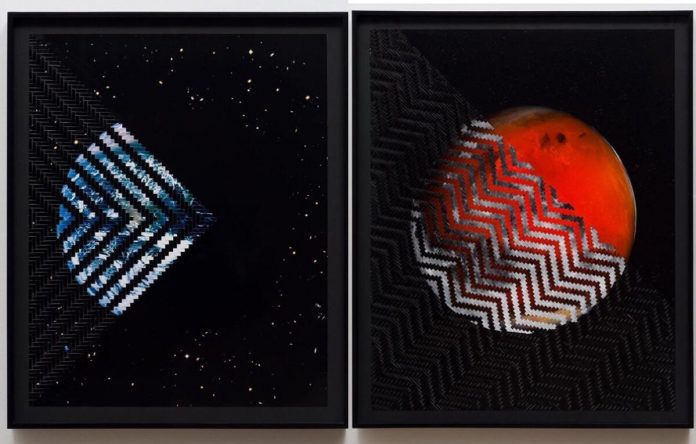
Clarissa Tossin, 'Old Planet' e 'Mars Rising', 2019. FOTO: Instagram Clarissa Tossin

The Brazilian Clarissa Tossin is one of the highlights of the Discoveries sector of Art Basel Hong Kong, being represented by the gallery Commonwealth and Council, based in Los Angeles, she introduces a new line of work. In 2018, Tossin had already exhibited in the Asian city, invited to display the video work Ch’u Mayaa (2017) at the Emerald City show at the K11 Art Foundation.

The artist spoke to ARTE!Brasileiros about the work she presents at ABHK 2019:

A!B: How did Octavia Butler’s book inspire you in these works for Basel Art HK?

Clarissa Tossin: The works presented at Art Basel Hong Kong are part of a larger work that emerged from my interest in the use of indigenous Amazonian traditions by Octavia E. Butler in her science fiction trilogy Xenogenesis (1987-89), where the Amazon became makes the site for a new civilization of human-alien hybrids, the Oankali, after the Earth’s self-inflicted ecological collapse. I love the Ooloi figure in the Butler series, they are the third indeterminate sex of Oankali who, in my opinion, incorporate certain characteristics of a native shaman, given their ability to store all the genetic information they acquire inside their bodies by ingestion of samples. The fact that Ooloi “ingests” samples of our living world to understand / decode it provides a connection to Anthropophagy, about cannibalizing culture as a survival strategy. I do not think the Anthropophagic Manifesto was one of Butler’s references but it was one of the links I made. I was also interested in the fact that the protagonist of the trilogy, Lilith, incorporate characteristics of an Amazon warrior (Icamiabas!). He could not stop thinking of her in a marajoara thong. These transpositions of my imagination created a particular image of the Amazon while I was reading Butler’s trilogy.

A!B: How did your gaze turn to the Amazon?

The rainforest of the Amazon is repeated in my work as a particularly rich place to investigate the implications of commodity chains of global capitalism and thus a perpetuation of the colonial forces represented in the environment, cultures and peoples of the region. But the Amazon is the repressed side of the narratives of Brazilian modernity that portray the capital of Brazil ahead and in the center. Growing up in Brasilia instigated my interest in counter-narratives about the built environment, and grounded earlier work on the Amazon, which focused on the legacy of extractive industries (incursions) and their architectural shifts in the forest, such as the Ford Company villages Fordlandia and Belterra.

A!B: What is the connection of your work with the thoughts of the great nations about the environment today?

The works of Art Basel HK address the brand left by the consumer society in Earth’s geological sedimentation as an alert for a collective behavioral change that recognizes that humans are part of nature and that we must work against the passivity that surrounds this issue.

I believe part of this space obsession comes from our anxiety about the potentially catastrophic results of global warming on Earth, and the other part is just the culture of fear at stake to justify the creation of an interplanetary industry that can eventually use money and public resources. Art Basel HK’s work focuses on the space race for Mars as an illusory way of addressing current environmental issues.

New airs at SP-Arte

Jorge Soledar, A morte do boneco, 2017-2019.

Between April 3 and 7, the Biennial Pavilion, in Ibirapuera Park, will be home to the São Paulo Art Festival (SP-Arte) again. Celebrating the 15th edition, the fair will have its art sectors led by new curators. In addition, there will be 165 exhibitors in total: 121 Art galleries, and 44 Design and inaugurates the OpenSpace sector, which takes sculptures to the outside of the building, curated by Cauê Alves.

When invited to the curatorship of the Solo sector, the Chilean Alexia Tala immediately thought of a phrase that was said to her by Aracy Amaral a few years ago: that Brazil was with its back to Latin America. What she wanted to say was that the country was always focused on Europe and the United States, without creating ties with the very continent of which it is a part. That is why, says Alexia, who offered as a proposal to Fernanda Feitosa, director of the institution, “use the fair, specifically the projects in Solo, as a platform to open ourselves to look at themselves, understanding that Brazil is so much part of Latin America like the rest”, says the curator to ARTE! Brasileiros.

The thought led her to a work in the series Profecias, by Randolpho Lamonier, an artist who will be present at the show in the sector, in which it is predicted that by 2050 everyone will discover that Brazil is Latin America. Alexia, who is also working on curating the Bienal de Arte Paiz in Guatemala, has been putting together ideas and shaping her desire to form a curatorial structure that speaks of territory through postcolonial theories: “I have been selecting artists since the territorial contextual perspective of Latin America How do we see ourselves? “” How many different identities were created, and what became fictitious? “These were the first questions that made me think about colonial ideology”, she explains.

In this perspective, the curator of SOLO takes to SP-Arte Rafael Pagatini (Brazil, OÁ), Maria Edwards (Chile, Patricia Ready), Ayrson Heráclito (Brazil, Portas Vilaseca), Nicole Franchy (Peru, IK Projects), Feliciano Centurión Argentina, Walden), Manata Laudares (Brazil, Sé), Randolpho Lamonier (Brazil, Periscópio), Alejandra Pietro (Chile, Die Ecke), Sandra Vásquez de la Horra (Chile, Bendana-Pinel) and Fernando Bryce (Peru, Espaivisor) . They are artists who, with very different ways of working, raise the questions she asked herself: “Timeless questions that are updated every time we see the exoticism demanded from outside for our territory”.

Whether in the recovery of “a religious memory and the mystical force of Afro-Bahian culture” made by Heraclitus, in the reconstruction of history and in reflection on it “from the record of what is necessary to keep within history and not forget” made by Pagatini or Centurión’s awareness of AIDS in a “personal chronicle of his way to death” Solo sector is bringing countries closer to the continent through common issues.

In the Masters sector, former Repertório, the new curator, Tiago Mesquita, did not seek a thematic or historical axis. The art critic says that the curatorial experience of an event like SP-Arte is still very new for him: “It’s very unusual in relation to other works that I’ve curated”.

Tiago chose to bring to the Masters works produced between the 50s and 80s, because they are works that “we can look at with a certain temporal distance” to understand them and also to understand the production of their respective authors. Carlos Fajardo (Marcelo Guarnieri), Ridyas (Central) and a project by Rubens Gerchman (Surface), among others.

The biggest surprise is perhaps in the Performance sector. Marcos Gallon, who also organizes the VERBO art performance show, chose not to allocate a space only for the works that will be presented. The performances took place in spaces destined to them scattered among the exhibitors. Gallon’s idea is to encourage the galleries to also take their performance artists, so the genre is incorporated as another possible medium of art, not marginalized in a closed corner. Also, according to Gallon, the vast majority of art galleries in the state of São Paulo represent artists who work with performance.

Gallon is also driven by the idea of encouraging collectors to buy performances, make them look at it as something that can be sold through the galleries: “So it’s brought to the trade show’s axis.” For this, SP-Arte will buy one of the works presented and donate to the collection of the São Paulo Pinacoteca. The work will be chosen by the staff of the institution, led by Jochen Volz. The artists Cadu (Vermelho), Cristiano Lenhardt (Fortes D’Aloia & Gabriel), Jorge Soledar (Portas Vilaseca), Maria Noujaim (Jaqueline Martins Gallery) and Jaime Lauriano (Galeria Leme/AD) will be in the sector.

Far Beyond Art

Vista de Tania Bruguera, Hyundai Comission, Turbine Hall, Tate Modern, 2018

The selection of the collective ruangrupa (that’s right,using lower-case letter initiating a proper noum and can be loosely translated from Indonesian as “a space for art “ )  for artistic direction of the Documenta 15, wich will be held in 2022 in the city of Kassel, is a coherent decision and in tune with the current state of contemporary art .

On the one hand the choice is amazing, seeing that the institution has suffered attacks by local rulers, when the previous edition had a US$ 8.4 million deficit, largely caused by sharing the shows with the city of Athens, reaching a total budget US$ 50 million.

Those were of political content attacks, typical of the current war strategy against the culture, also popular in Brazil, who ignored the essential points of the exhibition, focusing on an economic-financial loss, when we know that art and culture do not give profit anywhere. Document 14 had public record, with 1.230.000 visitors against 904.000 from the previous edition.

But the essential point is that Germany has not bowed down to the unwise politicians talks and, honoring the democratic tradition of the Documenta, invited to join the selection team, eight internationally renowned experts, among them, the director of Tate Modern, Frances Morris; the South African curator Gabi Ngcobo; the director of Van Abbe Museum, Charles Esche, and the director of Pinacoteca de São Paulo, Jochen Volz. These four names point to the representativeness of the cultural diversity of the committee.

“We chose ruangrupa thanks to the ability that the group has shown in call several communitie -, including public that go beyond traditional audiences of the artistic medium – , and promote local participation and commitment,” said the team, in a press release.

This statement emphasizes two axes that deserve to be watched carefully and reflect some of the most important proposals of the current art system: to go beyond “traditional audiences” and the involvement with the context.

Ruangrupa himself, or Ruru, as it is known, made it clear in the text they released  after being appointed: “If Documenta was launched in 1955 to heal war wounds, why shouldn’t we focus Documenta 15 on today’s injuries, especially ones  rooted in colonialism, capitalism or patriarchal structures, and contrast them with partnership-based models that enable people to have a different view of the world. “

In fact, “partnership-based models” is an essential expression to understanding contemporary art, since its beginnings in the years 1960, but that often follow being depreciated by archaic models that keeps the artist as author/criator of an commercial object.

However, since Hélio Oiticica and Lygia Clark, in Brazil, or Joseph Beuys, in Germany, the idea of work was questioned, being replaced by other proposals aiming at the expansion of what would be the place of art: be in the creation of the Free International University, as defended Beuys, in a therapeutic environment, to Clark, or a space for meeting, for Oiticica.

In a text from 2012 made to the 30th edition of the British magazine Afterall, the critic David Teh points out how ruangrupa “has done a deep commitment with Jakarta, both as a place and as subject, and to its population, both as public and as author. From day one, the group has made of the city — the noisy trade and administration machine not considered source of culture — a primary protagonist of an epic adventure of collective storytelling “.

In this sense, the idea of artist-proposer, defended both by Oiticica and Clark, is clear. According to Teh, in that article, “the prodigious capacity of the collective reaches a diverse aesthetic, incorporating from the punk street culture to the street culture, passing through desk research and ethnographic context, reaching  even procedural and conceptual experiments. To mix it up is a firm conviction that the participants are agents in a social history alive “.

This proposal of consider the public as an agent, after all, is everything that Beuys and Oiticica sought, in a program that advocated such a big expansion of the artistic field so that there would be no more boundary between art and life. “The museum is the world”, advocated Oiticica. “Everyone is an artist”, preached Beuys. Not by chance, was in Documenta 6, in 1982, that the German artist used the exhibition as a space for the Free International University, and two years later held a series of postcards with provocative texts, among them the phrase “With that  I get out of Art”, making clear the institutional breakdown manifest at the time of the so-called “return to painting”. A few months later, he would die.

For the past 50 years, many similar proposals were presented, as a French Nicolas Bourriaud, who came to draw a somewhat Eurocentric theory, the “relational aesthetics”, realizing a production that also use partnerships.

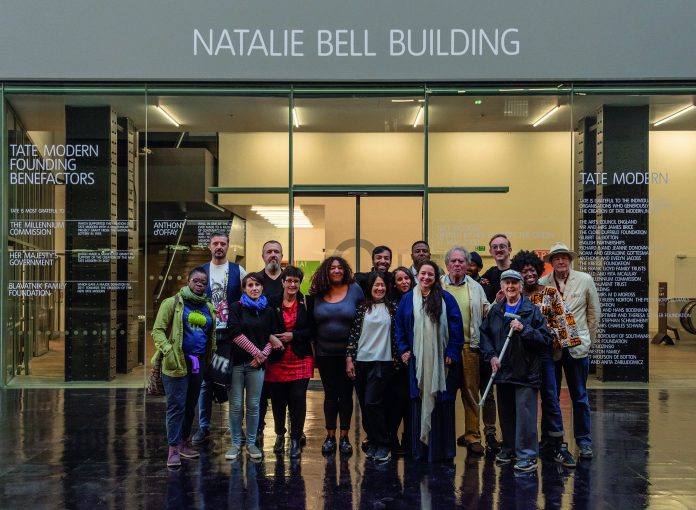
However, between recent and more radical proposals is the work of Cuban Tania Bruguera, at Tate Modern, during her installation at the Turbine Hall, between October 2018 to February of this year. Along with the occupation of the monumental space, she was also responsible for the program Tate Exchange, arm of the museum’s educational department, in an unprecedented action that changed the name of the building Boiler House of the Tate Modern to Natalie Bell, named after a local activist, in addition to working with a group of neighbors of the Museum, which occurred for the first time in the history of the institution, which will be kept for three years.

In lecture on Verbier, Switzerland, (see page xx), Bruguera defended what she considers the new way of understanding what is aesthetics today. To this end, she separated the word in Spanish, “Est Etica”, that is, be ethical. “This is the essential question of artistic production today, take into account the context, be ethical with the other,” said the artist. She even promoted encounters between residents and people in charge of the Museum.

In Brazil, there are many artists who come seeking to create bridges with groups and specific communities. Some people open their workshop transforming it in a reception space for trans people, while others participate in activities in occupations, such as Ocupação 9 de Julho or even work with institutions such as Redes da Maré, an that works with the group of favelas da Maré in Rio de Janeiro, generating actions of defense of these spaces. Are all activities that are based on a commitment to social issues merged with concerns on the field of art or that has in it a trigger. The Hcasa do Povo, in Bom Retiro, borough in São Paulo has been a privileged place for this type of partnership.

So when Ade Darmawan, a member of ruangrupa, States that “an artist must be able to constantly shake the faith of the people and everything around her or him, and contribute critically to social negotiations on existing values”, is found that the Documents 15 will remain the best thermometer for present art or not art.

A detour to Chapada

Na Página anterior, ALTO, residência artística criada por Marianne Soisalo, localizado nas montanhas de Alto Paraíso de Goiás.

It was thanks to the Stanley Kubrick’s film “Eyes Closed” (1999) that a Brazilian of Finnish family Marianne Soisalo created one of the most radical artistic residences amid the exuberant nature of Alto Paraíso de Goiás mountains, 230 km from Brasilia, in the Chapada dos Veadeiros.

Living in London in the 1990’s, Mari, as she is called by her friends, was one of the owners of the cabaret Madame Jojo, who was rented by Kubrick to record one of the scenes from his film when the character played by Tom Cruise meets his musician friend.

“With the money from the rent, she bought the land where the residence now operates”, says artist Rodrigo Garcia Dutra, who since last year has shared the responsibility for the ALTO residence with Mari.

Obra de Manoela Medeiros

Although the film was shot at the end of the last century, the land in Alto Paraíso was acquired only in 2008 and construction began in 2011. In the meantime, Mari, an environmental activist with a master’s degree in zoology from Cambridge University, slept in Bruce, her Land Rover, when she was in the region.

At the site, she had two houses built on separate trees, planned and built by a German specialist, one of them 30 meters high. The view from there is breathtaking, with blue macaws flying over the area. These homes are the home base of the Mariri Jungle Lodge, a creative home and a permaculture project space. It was along with the artist Karolina Daria Flora and the Spanish artist Rafael Perez Evans, currently living in London, that she created the ALTO, receiving artists both by subscribing to www.altoartresidency.com and by invitation, which has been organized by Dutra and Mariana Bassani.

The artist went to live in Alto Paraiso in 2017 to work at the Art and Education Institute of Goiás Department of Education and operate with art in public schools and a settlement of the Sem Terra. “After five months in the public service I decided to leave, and since I was in contact with Mari, I ended up getting involved in the residence”, says Dutra. Having graduated from the Royal College of Art in London in 2014, he returned to Brazil to attend the Histórias Mestiças show the same year at the Tomie Ohtake Institute, and eventually became involved with the Huni Kuin Indians, who were there for a ritual of ayahuasca in the work of Ernesto Neto. “Because of this tea, I decided to go back to Brazil”, explains the artist.

ALTO is a very private residence, with an open stay, because it’s aimed at artists who are involved with the land and with sustainability. This is the case, for example, of the English writer Olivia Sprinkel, who will spend some time there in the coming months, writing about global warming.

However, it’s not only activists who are invited, but also those interested in the theme, such as the artists Manoela Medeiros and Romain Dumesnil, who spent two weeks there last year invited by Dutra. Together, they have the Átomos, an autonomous art space, in Rio de Janeiro. The artists Marcia Ribeiro, Julie Beaufils, Daniela Fortes and Bia Monteiro have already passed through the residence at the invitation of Dutra, and in 2019 the artist Ivan Grilo is scheduled to arrive.

Obra do artista Romain Dumesnil

“I think it is important to move the spaces of production and reflection in art out of the big urban centers”, defends Dutra.

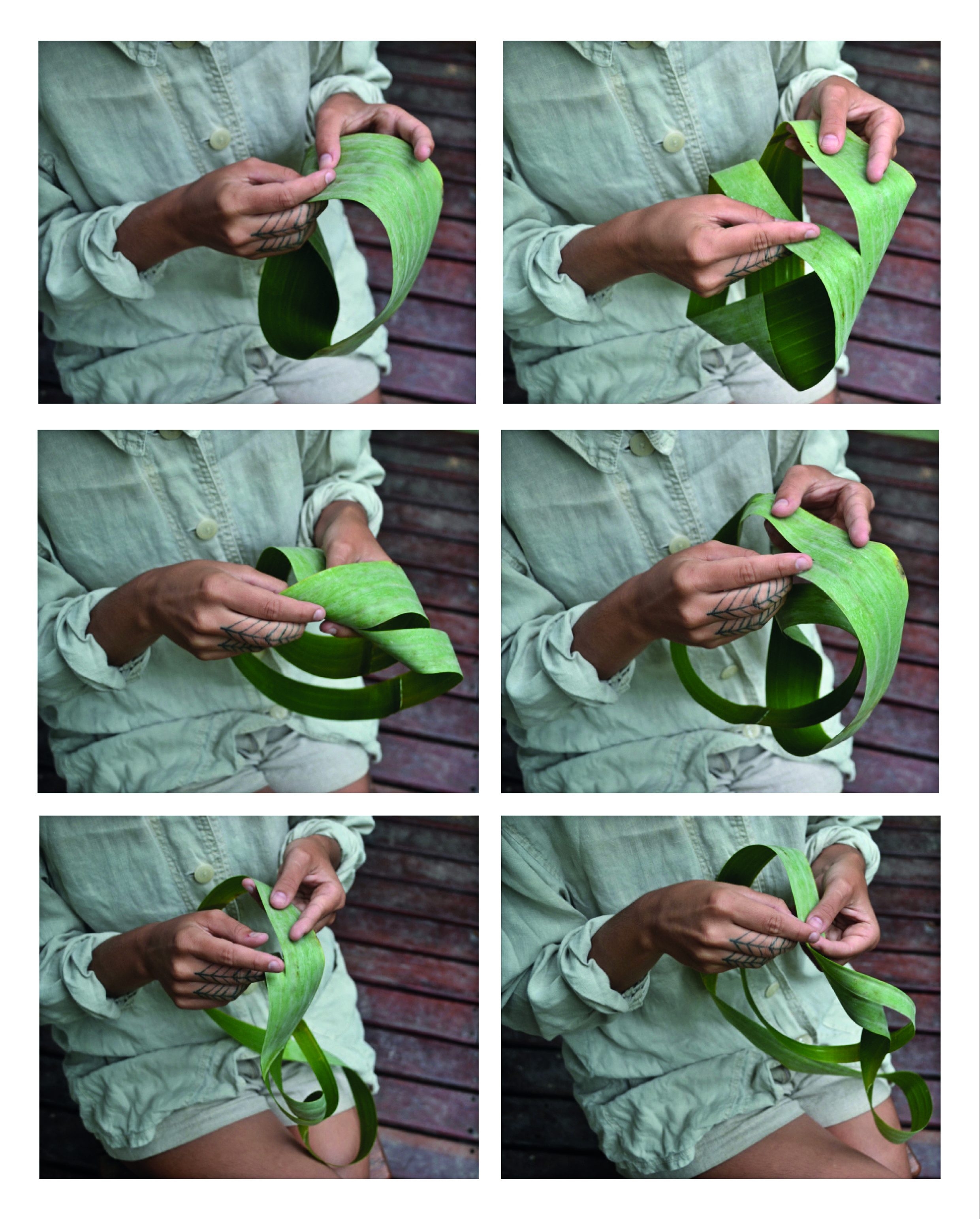
One of the works created by Medeiros in the residence is a rereading of Walking, emblematic work created by Lygia Clark, in 1964, in turn an appropriation of the tape of Moebius, where inside and outside constitutes like same space. While Clark’s work is on paper, Medeiros’s review is with Bananeira tree leaves.

While on the one hand the experience in Alto do Paraiso is dazzling because of the diversity of the region’s forests and waterfalls, it’s also challenging in the face of conflicts with agribusiness. He was probably responsible for the fire that occurred in October 2017, which destroyed 35,000 hectares of savannah vegetation in the Veadeiros National Park, soon after its expansion by about three times. It is speculated that the fire, started at the same time in many different places, would have been a counter-offensive of the farmers.

With this situation of polarization, which is the portrait of Brazil today, ALTO becomes an experience of immersion in an ecological sanctuary that, far from being mere tourism, is, after all, another way of experiencing the most central conflicts and dilemmas in the country.


Art needs identity

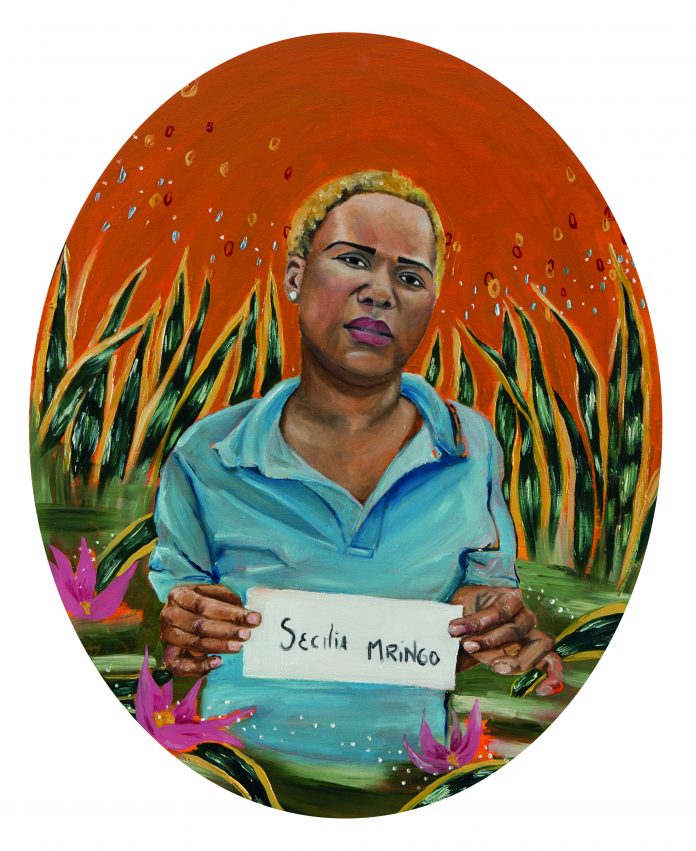
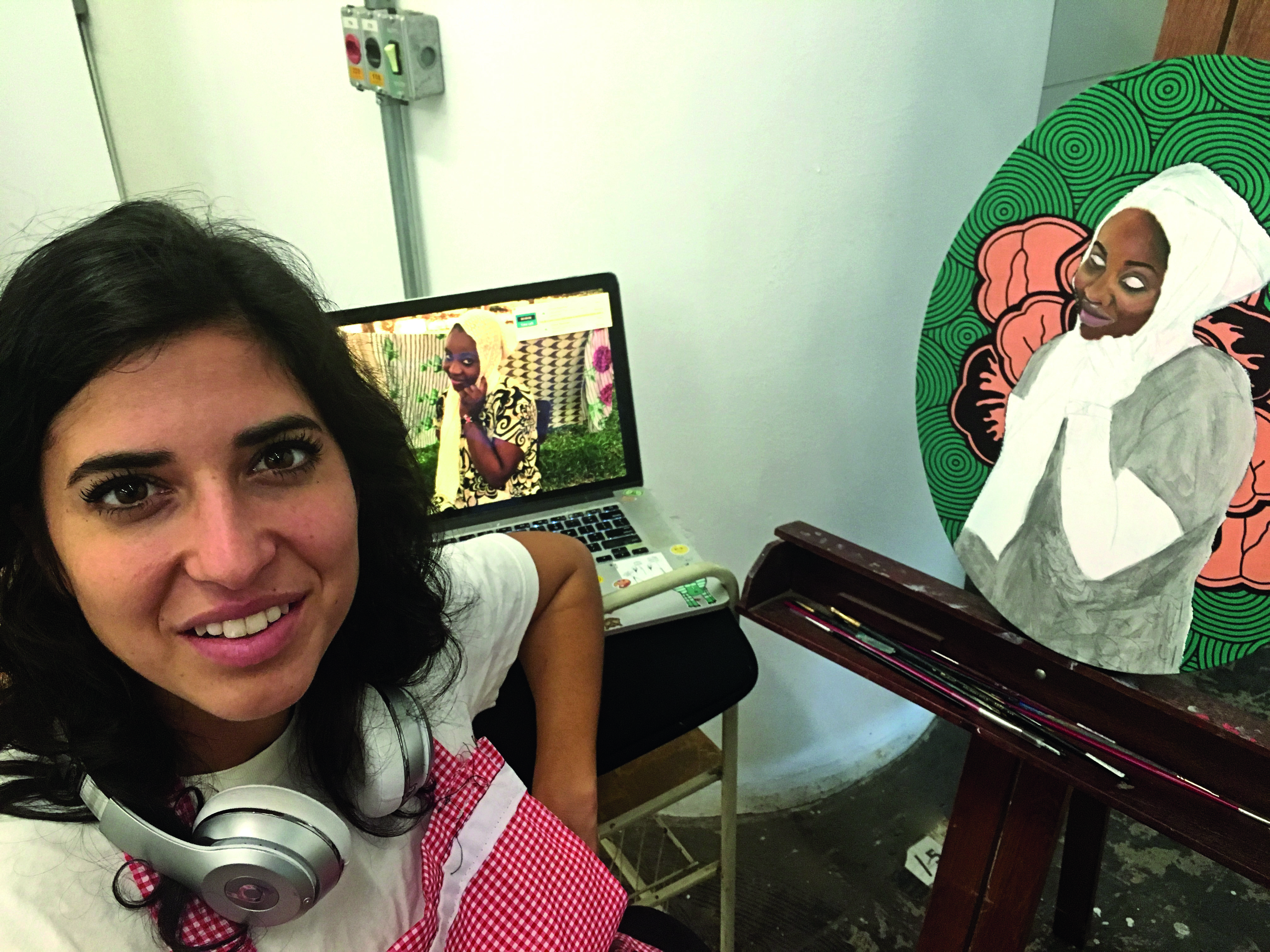
Retrato da série 'As Mulheres de Lá', de Fernanda Feher
Fernanda Feher em seu ateliê no espaço Pivô

The Pivô space, based in the illustrious Copan building in São Paulo downtown, increasingly reinforces its commitment to encourage research and experiments in art, welcoming artists, curators and researchers in programs they offer. One of them, the Research Pivot, is intended for residences offered during the year to Brazilians or emerging foreigners, molded according to what each one is seeking, lasting approximately three or four months each.

In the almost six years since its creation, 145 artists from 20 different countries have participated, promoting activities that allow important exchanges among the participants themselves, but also with external agents, be they art critics or the public itself. In addition, the program has a series of institutional partnerships that allow for valuable exchanges, such as the CPPC (Colección Patricia Phelps de Cisneros), the British Council, Matadero Madrid, Centro Cultural São Paulo and ArtRio.

In the first residence of 2018, 13 artists were participating. They are: Adrián S. Bará, Anna Costa e Silva, Carolina Cordeiro, Carolina Maróstica, deco adjiman, Fernanda Feher, Gilson Rodrigues, Leandra Espirito Santo, Maya Weishof, Renan Marcondes, Rui Dias Monteiro, Tomaz Klotzel and Vanessa da Silva.

ARTE!Brasileiros talked to Feher about the theme of the project that she develops at Pivô:

A:B When did you decide that you wanted to be an artist?

Fernanda Feher: I spent my adolescence drawing and painting, until my theater director told me: “You have to study painting”. That is how he left Brazil and studied for ten years at the PRATT Institute, in Brooklyn, New York, where I established my vocation.

But I’ve always been an idealist, an activist. I was involved in day-to-day social and political concerns. At that time, Fernanda had a painter and Fernanda was an activist. I did volunteer work. It was a division that bothered me.

Over time I created the project “The women of there”, where I was able to synthesize my true vocation, to bring stories into my work. I was relieved.

A!B: How did you create this project?

I started researching Africa and see where I could collaborate. I first went to Tanzania at a Canadian school that taught adult women to help them create independence for their husbands or how to strengthen themselves individually and become economically independent in order to work. I was there for a month and a half.

There are several organizations I came in contact with, one based in London, ORCHID, which impressed me a lot. They address the issue of female mutilation worldwide.

I presented my original idea: to travel, interview and paint these women and use the sale of labor to support the work of the organization.

So I went to Kenya and, unintentionally, to a region near Tanzania.

The work is very difficult, because awareness of genital mutilation comes up against the cultural issue. Despite this being banned by the government, traditional families wait for the school holidays to send the girls all at the same time to do the mutilation. For them, mutilation is part of the “woman’s growth.” Some women, not mutilated, can not marry or are bullied. Mutilation is part of “being a woman.”

It happens between the ages of 9 and 14, during which time the woman begins to menstruate. The custom is so ingrained that some families today do the mutilation at the moment the girl is born, as a way to circumvent the law, which now prohibits.

In other cases the midwife herself, when an unmanaged woman is going to give birth, maim the woman in childbirth. Imagine the fright!

Bringing light on this cultural myth imposes a very serious job. It can not ban and not support education because mutilation would not be necessary in development, but traumatic. It is extremely complex.

A!B: You did not tell us this story, yet we were captured by your work even without it being literal. By force, by color. How do you explain this?

My portraits are of women who discuss all this. Some are mutilated, others are girls who came from the schools where we were to listen or collaborate and teach.

I have an interest in telling their stories, their strength and joy, and not necessarily showing the place where they are victims. I want to try to bring the other side into my work. I like that, of them being able to see as a whole.

I think if I painted mutilated vaginas I would not be collaborating in anything with this process and maybe no one would come to ask me who these women are…