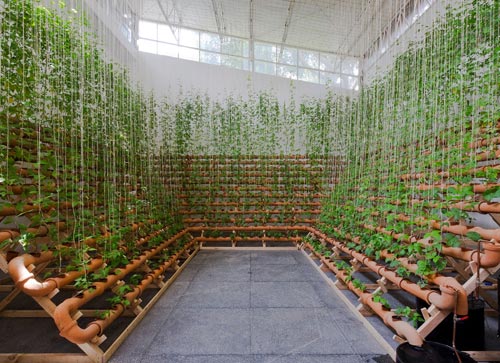
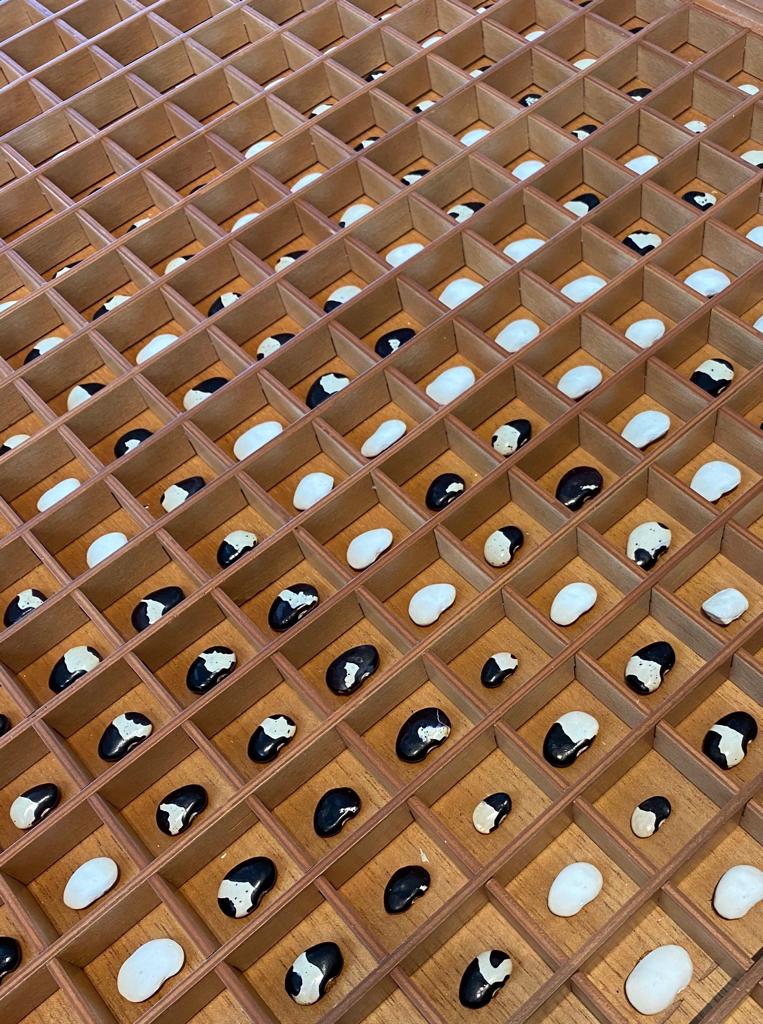
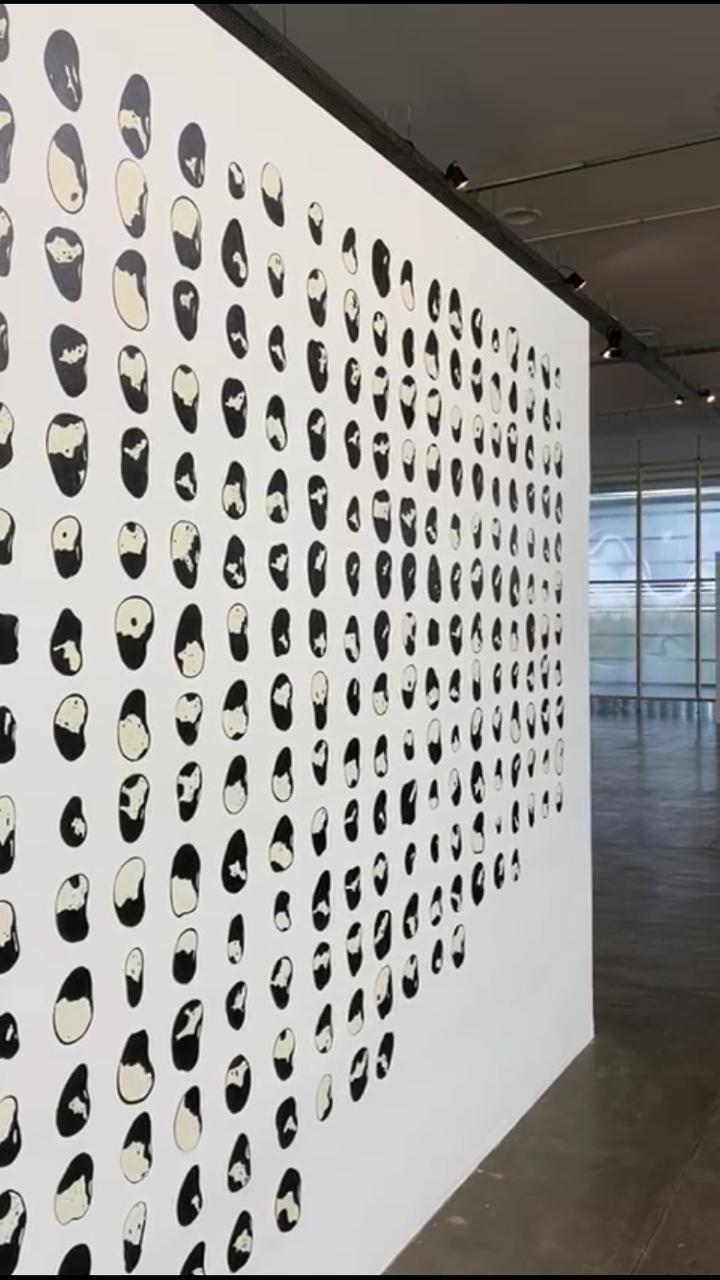
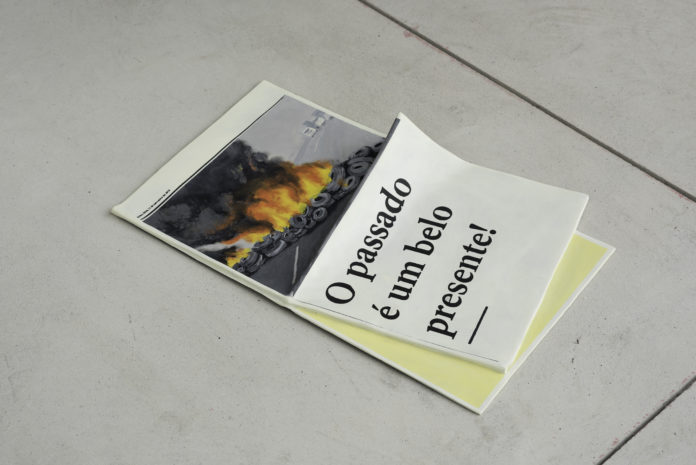
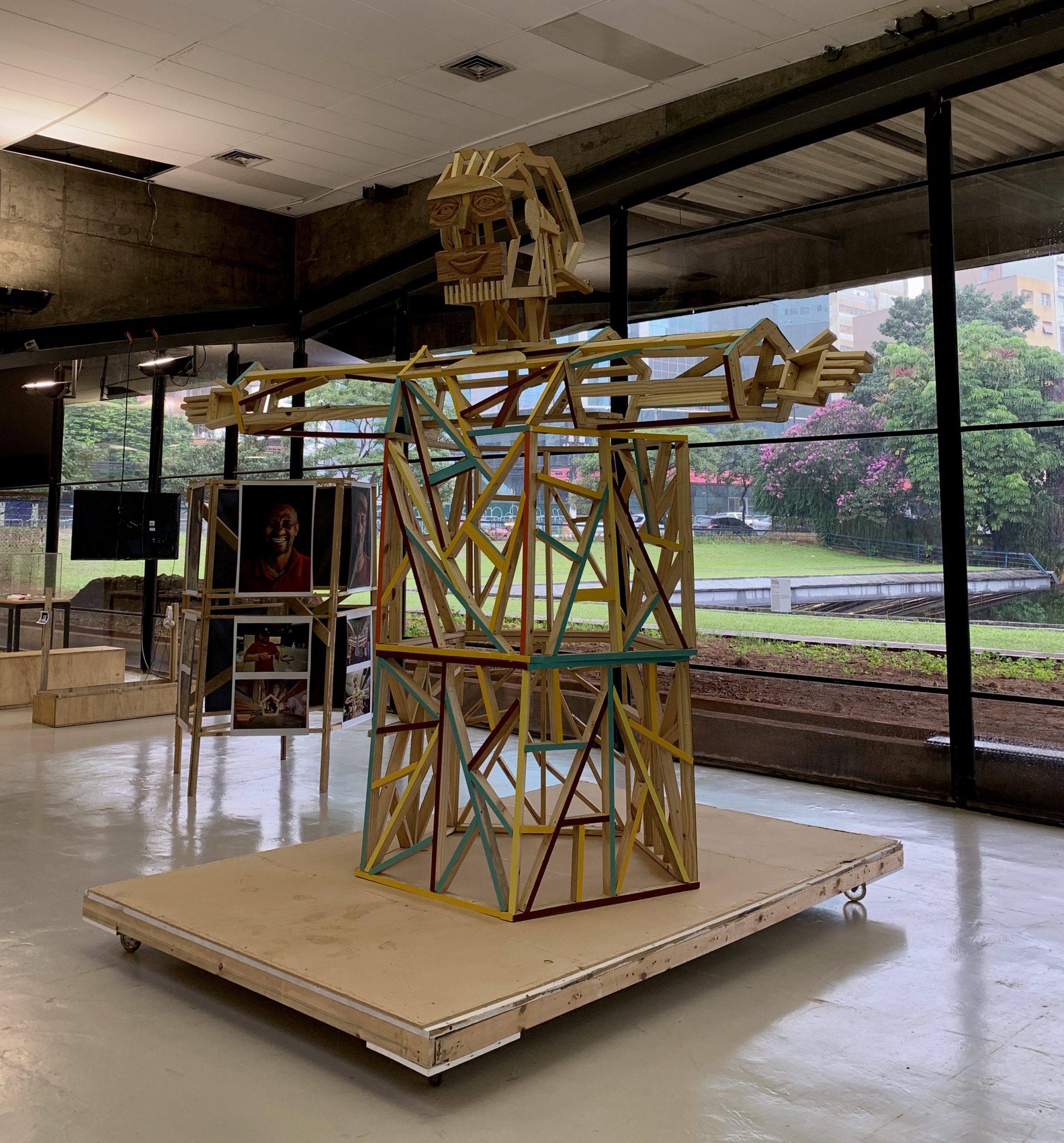
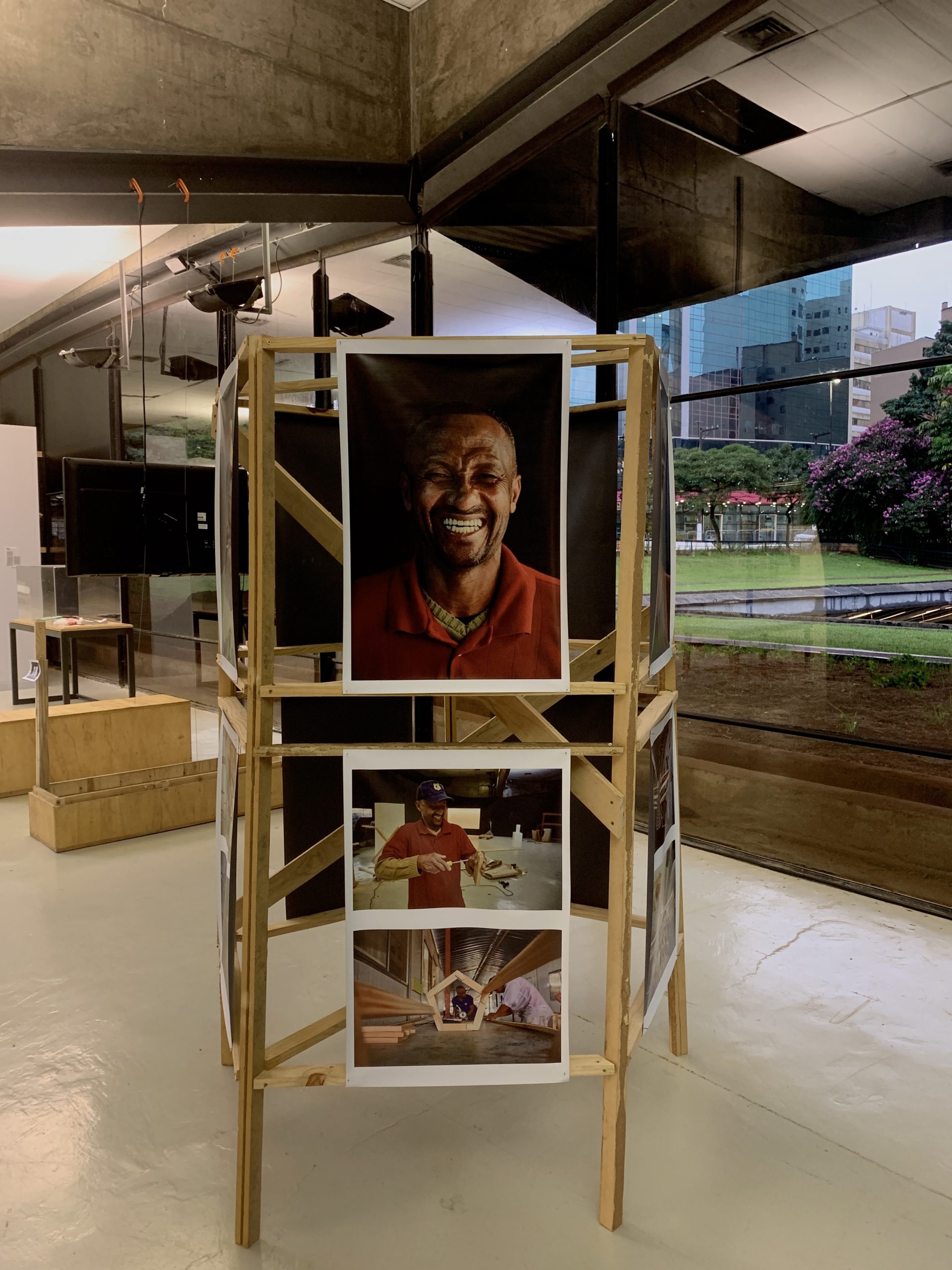
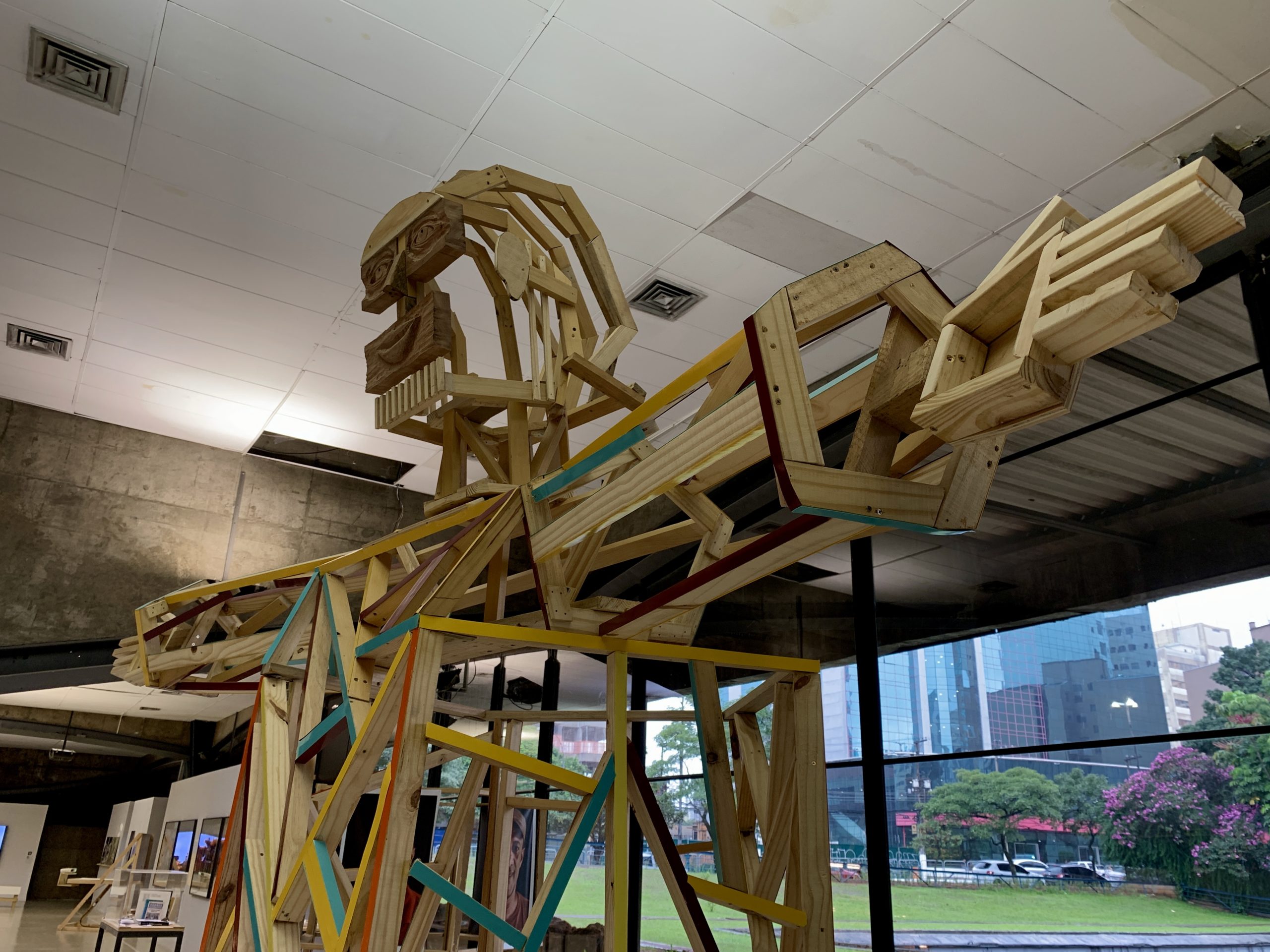
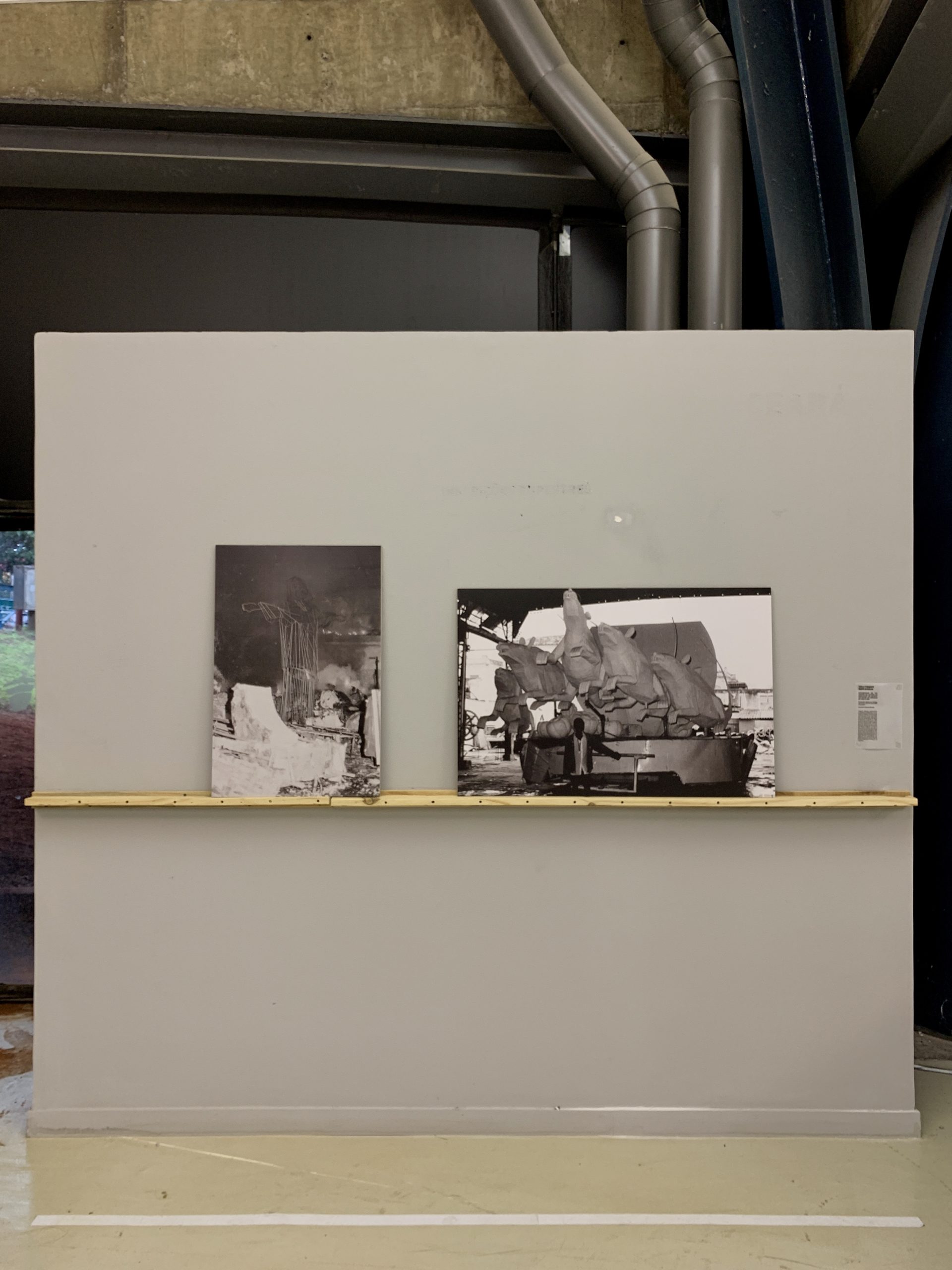
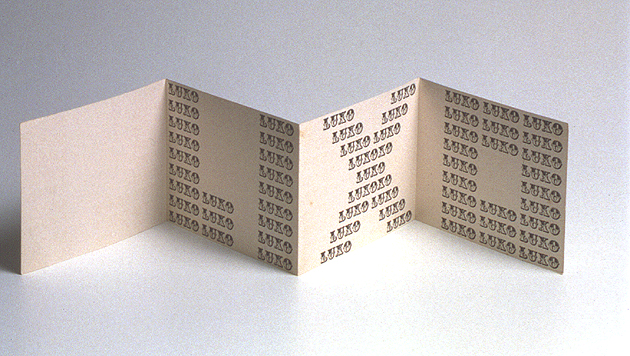
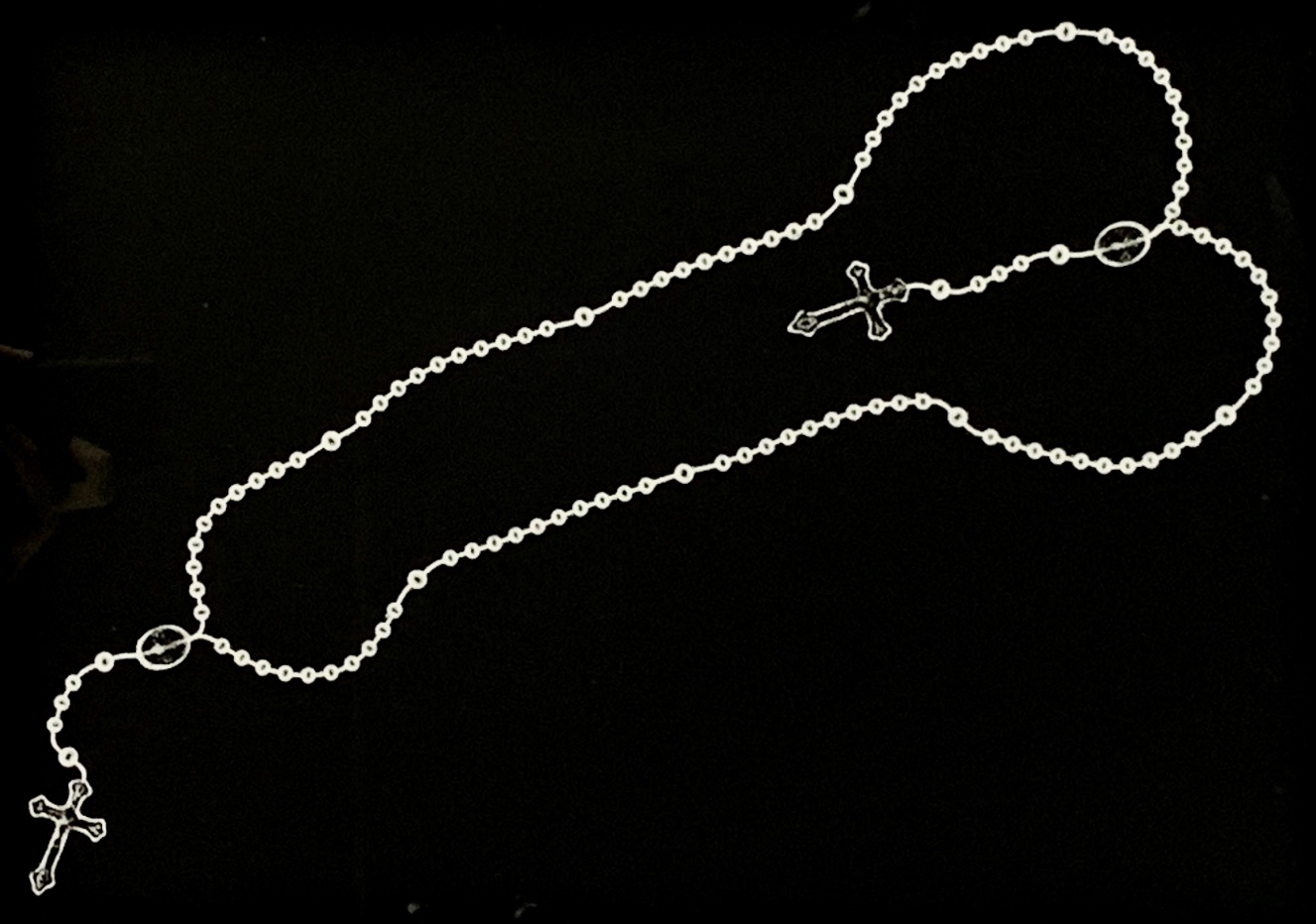
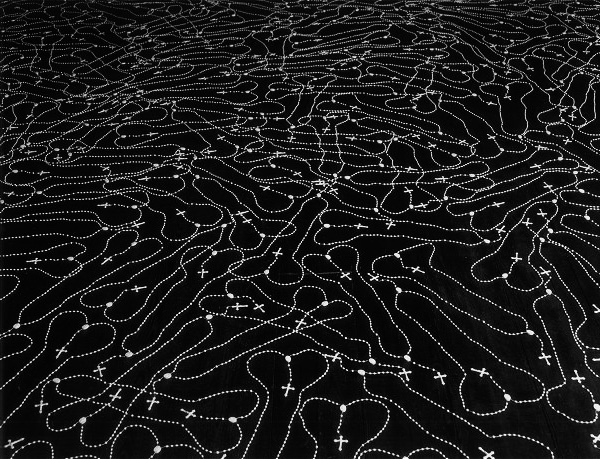
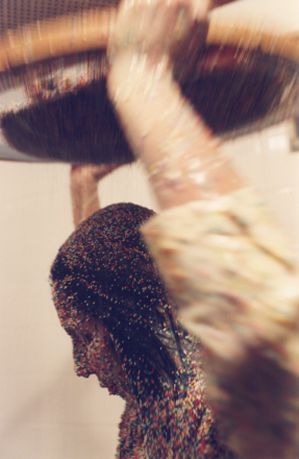
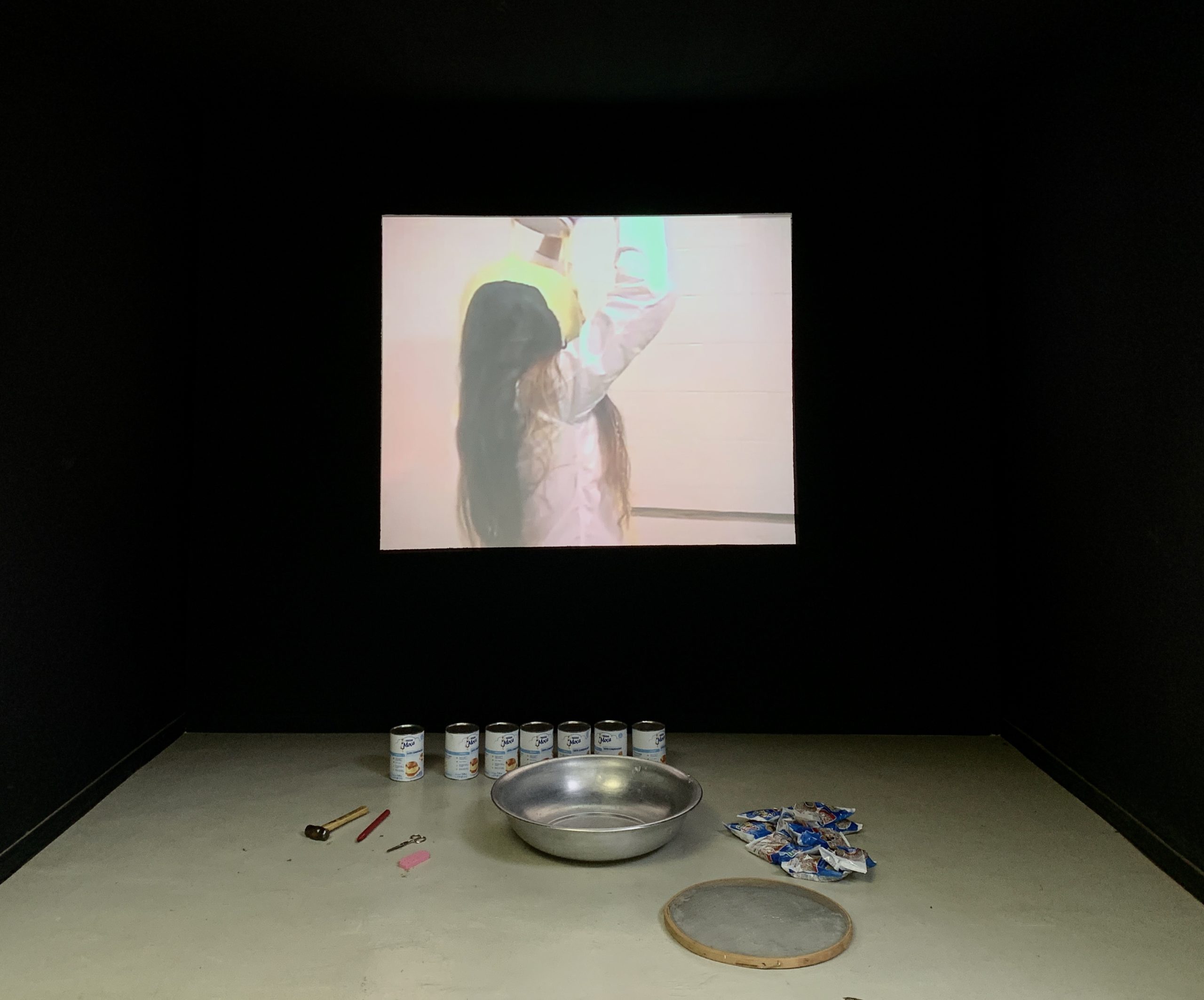
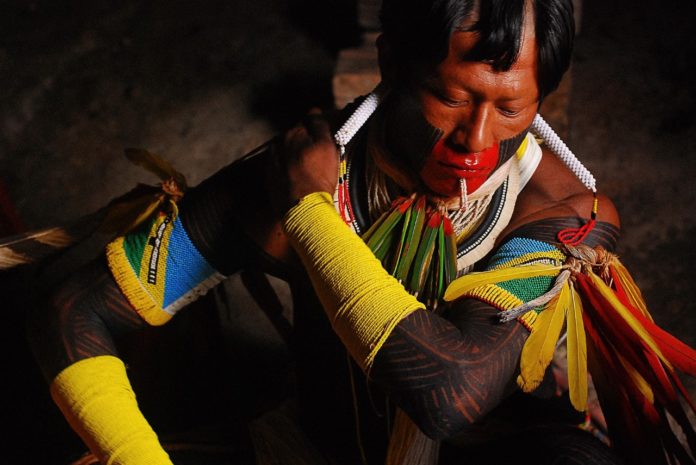
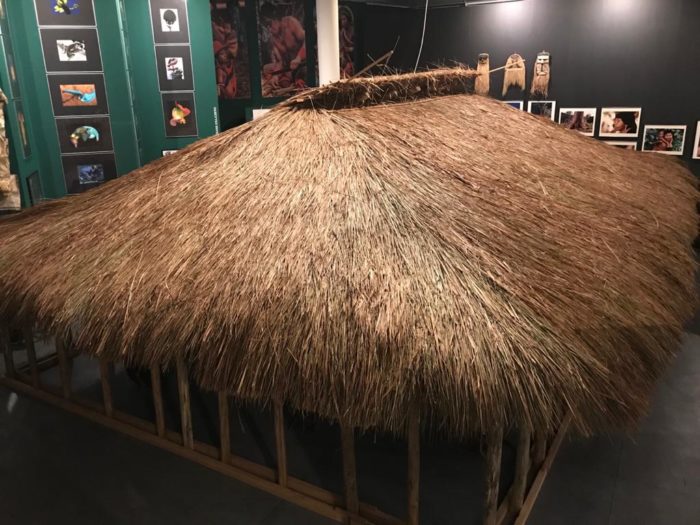
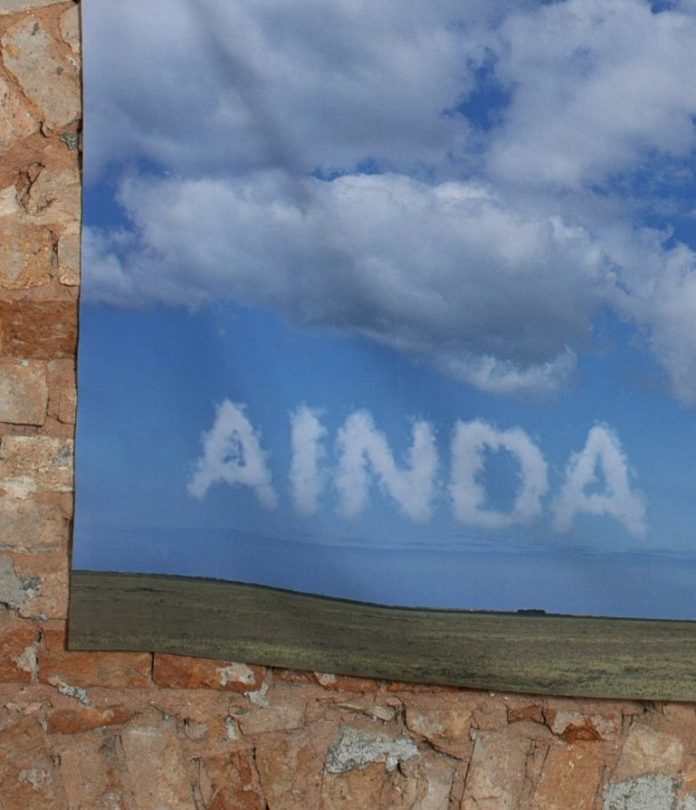
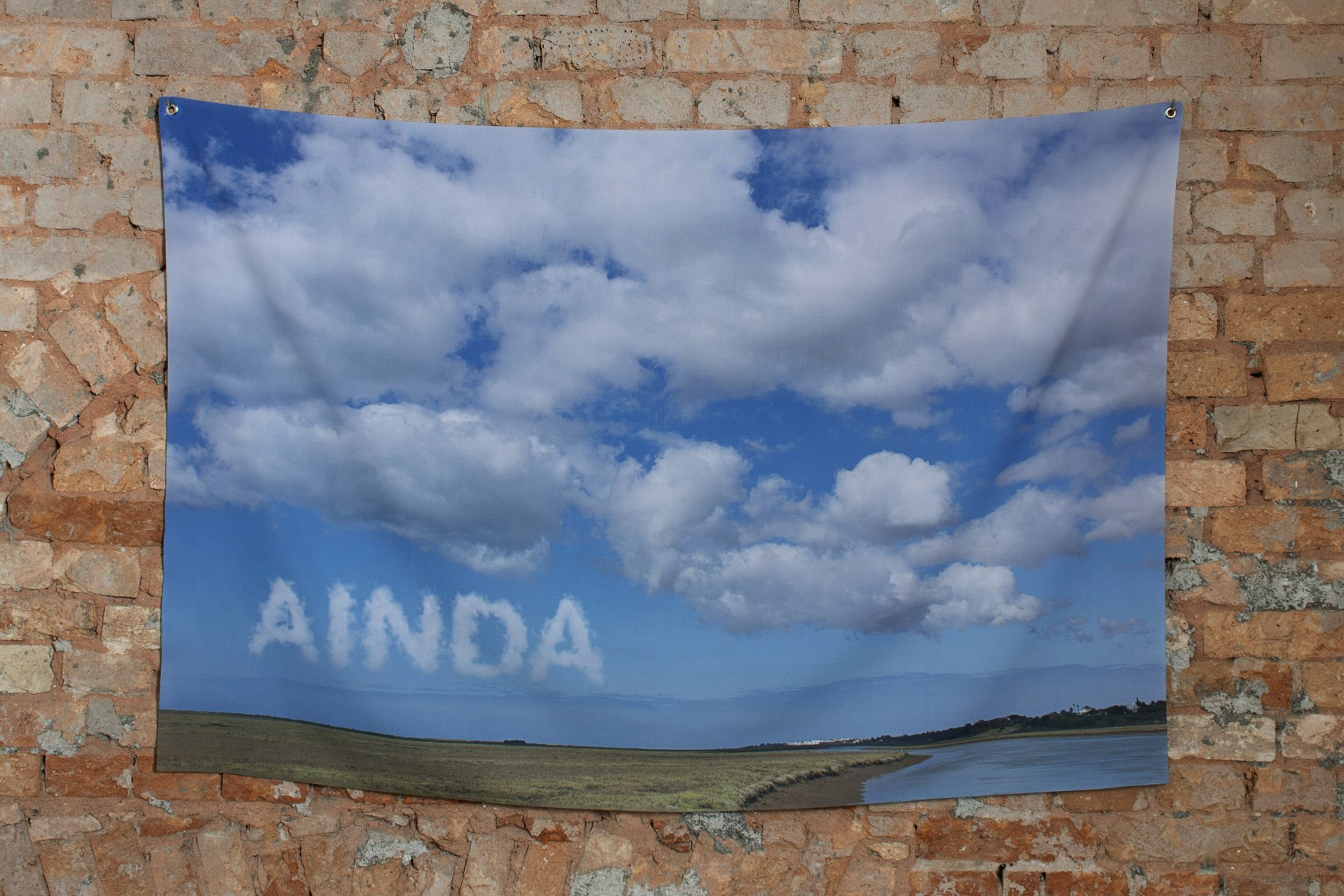
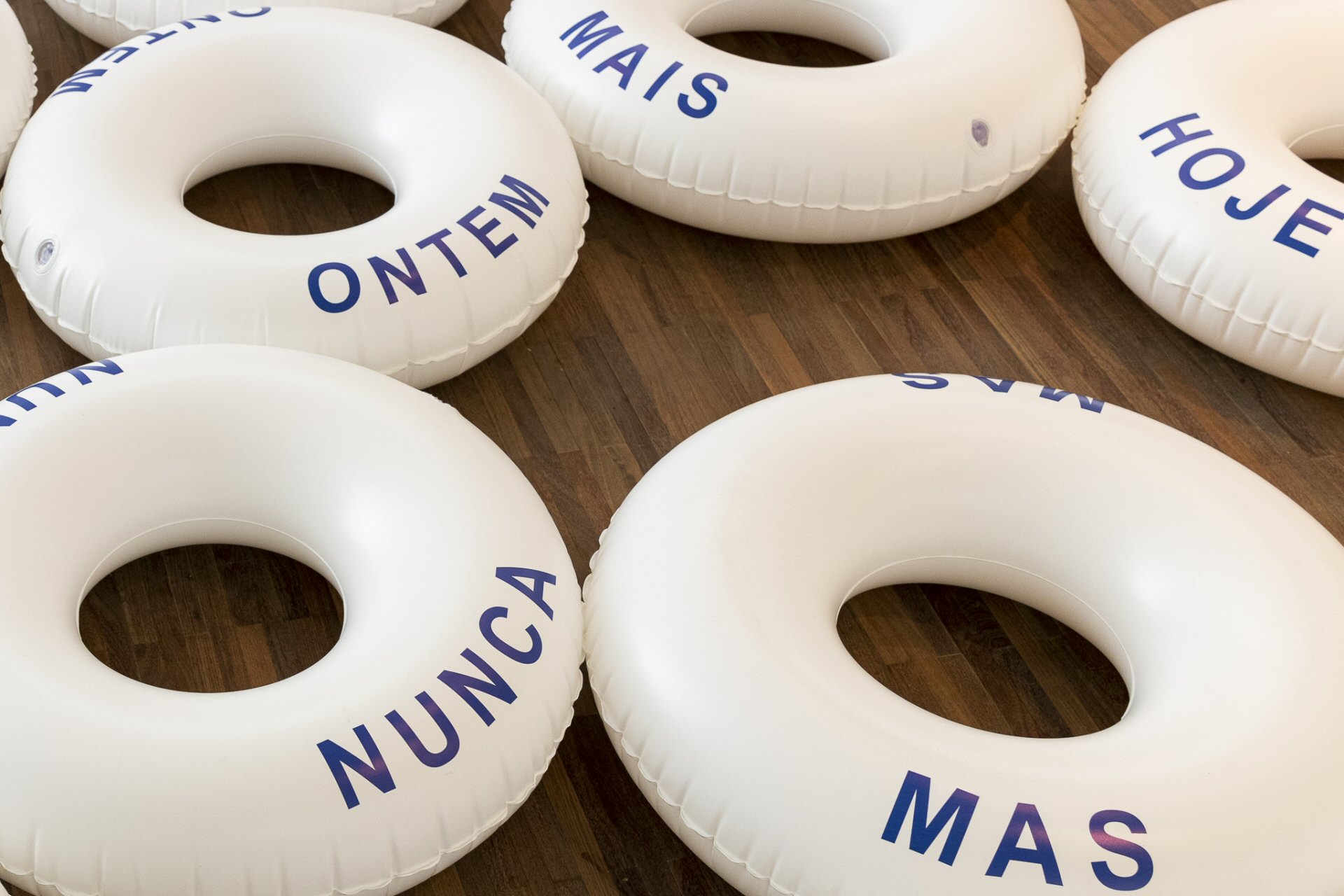
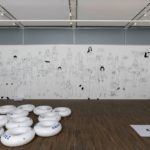
Vista e detalhes da instalação "Circa", de Anna Bella Geiger, montada na Bienal de Istambul de 2019.
Vista e detalhes da instalação “Circa”, de Anna Bella Geiger, montada na Bienal de Istambul de 2019. Foto: Gabriela de Laurentiis.
By Gabriela de Laurentiis
“Everyone knows which cities were made to be destroyed.” These words stuck in my thoughts about the Circa work, edited by artist Anna Bella Geiger at the 16th Istanbul Biennial. The installation brings semantic and poetic meanings of an uncertain time, something for which there is no p recision of dates. Geiger produces an installation combining ephemeral constructions – made of sand, dry cement, earth – and prefabricated objects – such as a small replica of a Bauhaus house, a small train and pieces of glass that form a small pool. There is also a video built in conversation with Philip Glass’s Akhnaten opera.
The first installation of the work was performed as part of the Breathing Project (2006), at the Eva Klabin Foundation Museum, Rio de Janeiro, curated by Marcio Doctors. The choice of materials makes the work gain, with each assembly, unique characteristics. Among the specifics of the Istanbul mount are the white sand roads, inspired by the area views during the wake of Brazil to Turkey: “I noticed these roads in the middle of the desert. This road layout I had not done in any of the previous installations”, says Anna Bella Geiger.
Poetic elaborations from maps, architectures and spatialities are striking in Anna Bella Geiger’s artistic practice. In Circa these discussions take the form of a fantastic / ghostly city with temporal-spatial configurations detached from linear periodizations. For researcher and artist Ana Hortides – who has done a series of montages of the work, including the Istanbul Biennale – “Circa presents a kind of city that mixes, at first glance, different cultures and temporal spaces in ruins, or apparently , close to collapse ”.
Vista e detalhes da instalação “Circa”, de Anna Bella Geiger, montada na Bienal de Istambul de 2019. Foto: Gabriela de Laurentiis.
The fragility of matter and the crumbling architectural constructions bring a sense of destruction, of territory being devastated. Geiger recalls that Circa’s first building was shrouded in the imagery of the Occupation of Iraq – which had been going on for three years – thickening through words the feelings of devastation wrought by the installation’s forms and materials.
The senses of the work expand in the situation of the Istanbul Biennale, curated by Nicolas Bourriaud, entitled The Seventh Continent. The term refers to a floating area in the Pacific Ocean of three million four hundred thousand square kilometers composed of seven million tons of plastic.
The impacts of human action on catastrophic dimensions in the framework of the Anthropocene – concept by researchers Paul Crutzen and Eugene Stoermer to call the geological age the effect of human activity on the globe – or the Capitalocene – as proposed by Andreas Malm, are underway at the Istanbul Biennale. politically these contemporary issues. The wars motivated by economic interests interspersed with religious problems, the impacts on basic resource infrastructures and the lifestyles of various regions of the planet make up the contemporary world. Circa brings this dimension.
The work was assembled in the projected building Emre Arolat which from 2020 will house the Istanbul Museum of Painting and Sculpture. There is also screened, among other works, the video O Peixe (2016) by Alagoas Jonathas de Andrade. Entering the building is impossible to disregard the views from the numerous windows. Of the vast majority of them what can be seen abroad are workers, scaffolding and unfinished structures. A construction site is formed in the midst of the waters of the Bosphorus, buildings and mosques, which make up the landscape of the region, which is undergoing a major redevelopment project.
Architect and artist Laura Nakel says that “the transformation of former Warehouse No. 5 on the edge of the Karaköy region into a museum shares features with recent major developments such as Puerto Madero in Buenos Aires, Wonder Harbor in Rio de Janeiro and V&A Waterfront in Cape Town ”.
Vista e detalhes da instalação “Circa”, de Anna Bella Geiger, montada na Bienal de Istambul de 2019. Foto: Gabriela de Laurentiis..
Circa’s production in this place has the effect of questioning the relations between the outside and the Museum. The ruined city of Geiger makes one think of Istanbul’s buildings and vice versa. As Geiger recalls, the work deals with “questions concerning spirituality, memory, history, and stories in a dimension of an extended space-time.” In the city of Istanbul all these questions resurface in the very structuring of urban space, sometimes in catastrophic dimensions. Nakel recalls that in the Museum region there is “a process that begins in the 1990s, in which galleries and art collectives occupy the old abandoned warehouses, initiating a process of gentrification in the region, intensified with the arrival of large private investors”.
In the crossing between continents, however, Circa’s buildings gain another layer of possibility: hopeful transformation. For Hortides “the inclusion of a wet, living and seemingly fertile land makes the passage of time at the Istanbul Biennale assembly a little more hopeful for things to come, a harbinger of construction and transformation, despite disasters”. Anna Bella Geiger with her crosses through uncertain times makes one imagine multiple and agonistic spaces, elaborating a vibrant and alive poetics.
¹ Bourriaud, N. “The Seteventh Continet: These Upon Art In The Age Of Global Warming”. In Seventh Continent. Catálogo da 16ª Bienal de Istambul. Istambul, 2019. P.47.
* Gabriela De Laurentiis is a visual artist and researcher. She is the author of the book Louise Bourgeois and feminist ways of creating. She holds a degree in Social Sciences from PUC-SP and a master’s degree from the Department of Cultural History at UNICAMP. She is currently a doctoral student at FAU-USP, with research in Anna Bella Geiger, who writes for this issue.
his is our last issue of 2019, a year where all the productive areas in this country had to work beyond their strength in a petty environment. It was a year of economic difficulties for most of the population. If that were not enough, we are in the midst of an incredible display of intellectual poverty.
Within the poverty of widespread thinking, the government has decided to make culture an appendix to the Ministry of Tourism. They may have thought: “See, in the tour guides there are directions to the movies, theaters, and museums, let’s put it all together.” It would be comical if it was not tragic.
Nevertheless, as we listened to the stupidity of countless bravados – some of which set us back decades in the history of our lives and the country –, art saved us once again, with its absolutely unbreakable strength. The possibility of still having access to culture allowed the population to go massively to exhibitions in museums and cultural institutions.
ARTE!Brasileiros, in partnership with Itaú Cultural, managed to hold a deep debate on various approaches and possible alternatives for the sustainability of institutions and the importance of cultural management at the Cultural Management: Contemporary Challenges seminar. From then on, we decided to start a series of interviews that would allow us to hear and follow other voices permanently. The idea of a participatory cultural institution, capable of involving the population in its causes, and not just a space of contemplation, is increasingly reinforced.
In this petty role, the state only deepens the scars of centuries of discrimination and violence and paves the way for more violence. In art the answer is an active denunciation. Artists seek to express themselves, aesthetically and ethically. They research archives, supports and themes that help them talk. Gender-based racial struggles against censorship were present throughout the year in the works of biennials, such as Sesc_ Videobrasil, in prizes at both Marcantonio Vilaça and Pipa, and in most national exhibitions.
Na capa, obra de No Martins, da série #JáBasta!, 2019. Em exibição na 21ª Bienal Sesc_Videobrasil.
More than 30 artists participate in an exhibition at the 9 de Julho Occupation in São Paulo, engaging in supporting the struggle for housing movement. Young artists like Aline Motta, one of the Marcantonio Vilaça Prize winners, make her work a permanent search, at its roots, for the collective memory of thousands of Brazilian families built (or destroyed) in the violent process of the country’s formation, based on slavery and in the patriarchal structure.
Guerreiro do Divino Amor, winner of this year’s Pipa Prize, in completely original language and experimentation, names the oxen and denounces the maneuvers of fascist evangelical sectors, defenders of outdated customs and the responsibility that certain media groups are taking on it.
Our cover, the work the artist No Martins, from São Paulo, which is undoubtedly part of this ethos, somehow synthesizes our feeling, also expressed in the text extracted from the book Critique of Black Reason, edited by n-1 edições, by Cameroonian Achille Mbembe: “The Black Man, despised and profoundly dishonored, is the only human in the modern order whose skin has been transformed into the form and spirit of merchandise—the living crypt of capital. But there is also a manifest dualism to Blackness. In a spectacular reversal, it becomes the symbol of a conscious desire for life, a force springing forth, buoyant and plastic, fully engaged in the act of creation and capable of living in the midst of several Introduction 7 times and several histories at once”.
"Missão/Missões (Como Construir Catedrais)", (1987/2019). Foto: Carol Mendonça/ Divulgação
À frente, “Olvido” (1987-1989). Ao fundo, “Entrevendo” (1970/1994). Foto: Everton Ballardin/ Divulgação
In Cildo Meireles’s vast and diverse work, if there is construction, there is also deconstruction; if there is reality, there is illusion; if there is visibility, there is what is hidden; if there is reason, there is madness; if there is affection, there is trauma; if there are affirmations, there is the mystery; if there is order, it can itself generate chaos; if there is formalism, there is abstraction; where there is a way, there is the deviation; in the circuit, short circuit; if there is vastness, there is also the ghetto; if there is version, there is subversion; if there is balance, he is tense; and if there is violence, there is resistance. It is not necessarily about oppositions, much less incompatibilities, but about realizing that in the carioca artist’s striking production there are no easy and unique truths, and that the obvious and most usual ways are always being challenged – things are not always what they seem.
Thus, those who visit Entrevendo, at Sesc Pompeia, one of the greatest exhibitions ever held by Cildo Meireles, 71, will come across paradoxes, ambiguities, ironies, contrasts and concerns that run through the 150 works of the exhibition, curated by Julia Rebouças and Diego Matos. In works in various supports, languages and scales, scattered throughout the vast spaces designed by Lina Bo Bardi, the arprojetist presents a production that activates, expands and shuffles the senses, as Rebouças explains. “It is a ct that deals with the idea of meaning from its multiple definitions. Thinking not only of these perceptual capacities linked to touch, hearing, sight, smell, etc., but also thinking of sense as a measure, as direction, as balance, as a sense. And it is very important to understand that in Cildo’s work these forms of perception of the world are affirming themselves, but they are also contradicting each other, challenging each other”, she says.
Entrevendo, the work that names the exhibition, proposes that the public put two ice stones, one sweet and one salty, into a large cylindrical installation and walk towards a hot air source. The work, designed in 1970 and first performed in 1994, triggers different sensations and forms of understanding in the visitor’s own body as it deals with the contrasts between sweet and salty, hot and cold, light and dark. “And interestingly, it is a job that requires very little vision. The idea that vision is the primordial sense of artistic experience is very much challenged in Cildo’s work”, says Rebouças. The artist agrees: “At the beginning of the last century, Marcel Duchamp was already talking about the intention of liberating art only from retinal rule. Here in Brazil, since the 50s, especially since neoconcretism, this has become a very important thing. Exercising this multi-sensoriality has become a specificity of Brazilian production based on Lygia Clark’s Oiticica… And some of my works also deal with it”.
“Eureka/Blindhotland” (1970-1975). Foto Carol Mendonça/ Divulgação
The contrasts, ambiguities, paradoxes or subversions, which are also invitations to the imagination, are notable in other works that sometimes make explicit these characteristics in their own titles. In Blind Mirror (1970), made of a gray and misshapen mass without reflection; Descala (2003), with dysfunctional stairs; Virtual Volumes (1968-969), in drawings that present volumes without physicality; Invisible Sphere (2012), with an aluminum box that, when opened, suggests a sphere due to the internal absence of material; Obscura Luz (1982), in which a shadow forms the design of a lamp; in the series of zero notes or coins, which question the relationship between real and symbolic value and explain that the value stamped on money is an abstraction; or in works such as The Shortest Distance Between Two Points is a Curve (1976) and in the works of the Physical Art series (1969).
The Blindhotland series, in turn, with three works on display, confuses the visitor when his vision is “betrayed” by the appearance of the objects. In the famous Eureka / Blindhotland (1970-1975), for example, dozens of balls of the same size, color and shape – scattered for manipulation by the public – have significantly different weights; In Blindhotland / Ghetto, otherwise, balls of different sizes have the same weight, again creating a kind of cognitive confusion that defies the senses. Like them, several other works of the exhibition invite the visitor to interaction, to an experience that comes through participation, dialoguing with what Cildo calls the “seductive character” of the visual arts.
“I think it has two characteristics that the fine arts should preserve, two aspects that should never be overlooked. First is the character of seduction. I think in a way conceptual art at first tried to clean it up, make it aseptic, and you lose your chance to deal with the seduction content a job might have”, says the artist. “And the other thing is that the fine arts is an activity that allows every new idea to start from scratch. You want to make a movie, you can have a thousand ideas and ways, but that without pre ends in the frame. In fine arts there is no such thing, you can take anything of any kind with any material using any procedure, and you get to the final work”, he says, also explaining that he never had a definite method of production.
“Para Ser Curvada com os Olhos” (1970-1975). Foto: Carol Mendonça/ Divulgação
Poetic and political vein
Both seduction and the variety of materials and languages are also present in works that deal more explicitly with socio-political and economic issues, and deal with memories that are repeated in Brazilian history. In Mission / Missions (How to Build Cathedrals), thousands of coins scattered across the floor connect, through a column of stacked wafers, to the bones hanging from the ceiling, creating an “anti-cathedral” that denounces the violence of colonial exploitation and its thirst for financial accumulation. “Indigenous extermination, this truculent history, this is a question that persists over time. When I did this work in 1987, thinking of the Seven Mission Peoples of the 17th century, I was speaking generically about this process of annihilation. But it ends up falling like a glove to the current situation”, says the artist, without losing, however, the hope that there may still be justice. “But sooner or later the responsibility for these crimes will fall on the perpetrators”.
The feeling of contemporaneity that runs through the exhibition, according to Rebouças, is a consequence not only of the choice of works that dialogue with “absolutely unresolved issues”, but “the result of a very complex and forceful production, of Cildo’s ability to manage affections rather than responding to specific events. He is responding to a feeling that was shared in another moment and is still shared today”. And this does not refer only to Brazilian history. Among the works that deal with the colonial structure are also Olvido (1987-1989), in which thousands of candles and ox bones surround an Indian-style tent – lined with money notes, and Amérikkka (1991/2013). Referring already to the title of the far-right terrorist and supremacist organization Ku Klux Klan, the installation creates a tense atmosphere by placing the public on wooden eggs, on the floor, and targeted by gunfire projectiles attached to the ceiling.
Like Amérikka, the show features a series of other works that have never been exhibited in Brazil, or that have only been presented in the country for a long time. According to Rebouças, at least two generations have not had contact with a wide cut of Cildo’s work, since the artist’s last major exhibition in Brazil toured the Rio de Janeiro and São Paulo MAM in 2000. Little interest in setting up exhibitions – at least today – Cildo says that one of the reasons that attracted him in the proposal was the location of the show at Sesc Pompeia, where there is a large circulation of people of all classes and ages and free admission. “This characteristic of Sesc, which is a deep respect and interaction with the surroundings, with the community, also brings an audience that is not specialized, specific to the fine arts. And this expansion interested me”, he points out.
“Missão/Missões (Como Construir Catedrais)”, (1987/2019). Foto: Carol Mendonça/ Divulgação
Parallels with the dictatorship
It is not only between the present day and colonial history that Entrevendo draws parallels. A strong performer during the years of the military dictatorship (1964-1985), Cildo is emphatic in denouncing the abuses of the current federal government and the similarities with the military period. “But the current one is even more sinister and more ridiculous because it is paradigmatic ingenuity”, he says. The repetition of the history in the deaths of journalist Vladimir Herzog in 1975 and Councilwoman Marielle Franco in 2018, both fruits of political persecution, appears in the famous Insertions in Ideological Circuits, a series started by the artist in 1970 and developed to this day. .
By stamping, during the dictatorship, cruise bills with the question “Who killed Herzog?” and, nowadays, real notes with Marielle’s face, Cildo proposes to rotate symbols, social criticisms or slogans on objects of the everyday life (the project began with returnable Coca-Cola bottles), creating a kind of counter-information network in pre-existing circuits. As the artist himself explains, the Insertions have the ability to give a “voice to the individual in the face of the macrostructure”, in addition to raising questions about artistic authorship and the place of the artwork, outside of specialized environments.
Although resistant to any framing of his work as “engaged art” – “I have disgust for pamphleteering art”, he said once said – Cildo is not afraid to highlight the political concern present in his work. And tell how it came about. “It was in 1969 that I felt compelled to deal even more strongly with political issues”, he says about the year he participated in a show where the Brazilian representation for the Paris Biennial Youth would be selected. “Three hours before the inauguration, with the exhibition already set up, DOPS agents surrounded the Rio MAM building and demanded the cancellation of the exhibition. There was even the beginning of a military police inquiry involving all the artists. And I, who in that exhibition had formal works, without political nature, from then on I felt almost obliged to refer to these political issues in my work”, he recalls.
Obras da série dos “Zeros”. Foto: Carol Mendonça/ Divulgação
Relating the current context and the dictatorial period, the artist is outraged by recent episodes of censorship and the kind of treatment culture has received from the government. “We’re witnessing this kind of thing, an idiot like this guy who was from Funarte (the current secretary of culture Roberto Alvim) has come to the public to say that Fernanda Montenegro is nasty and liar. She, who is a kind of national treasure. And some guy comes and thinks he can defecate in public. This has become the hallmark of this government”. And he concludes: “But there is a physics law that says that every compression corresponds to an explosion. So the more you squeeze something, the more it will provoke a reaction, that’s a basic thing”.
Público interage com obra na abertura da exposição.
By Dereck Marouço, in Berlin
T
he exhibition Love and Ethnology: The Colonial Dialectic of Sensitivity (according to Hubert Fichte) was held in honor of the German author’s series of 19 books that together form a significant body of work on his travel experiences, wrapped between sex and spirituality. The importance of his narrative lies, beyond the documentary and prose character, in the autobiographical force. The project was supported by Goethe Institute and takes place after previous editions in Lisbon, Salvador, Rio de Janeiro, Santiago and Dakar. In Berlin, the project is curated by Diedrich Diederichsen and Anselm Franke, who mixed works exhibited in previous exhibitions with new additions.
Hubert Fichte (1935 – 1986) lived radically at a crucial time in recent German history. Son of Jewish father, as a child had to hide in a bomb shelter to escape the Nazi threat. He has been to Brazil three times, between 1969 and 1972, having experienced African-Brazilian spiritual practices during this period, as well as many homosexual relations, even living with a woman, the photographer Leonore Mau. It is in this context that he begins to constitute his History of Sensitivity, based on travel as an investigative method, when experiences and impressions are key to a thorough knowledge of other cultures. Fichte was a fringe as being gay was still a crime in Germany in the 1960s. But when traveling to countries with dictatorial regimes in the 70s, such as Brazil, Portugal and Chile, he realizes the real antagonist of his History of Sensitivity: torture and neglect of human rights.
Vista da exposição na ocasião de sua abertura em outubro passado.
For the exhibition in Berlin, more than 170 works were densely grouped, including painters such as André Pierre (Port-Au-Prince) and Canute Caliste (Trinidad) and Harlem Renaissance artists such as Camille Billops, Owen Dodson & James Van Der Zee to German contemporary media artists such as Michael Buthe. There are also a good number of Brazilian artists in the exhibition: Virginia de Medeiros, Ayrson Heráclito, Miguel Rio Branco, Alair Gomes and the Bonobando group, all exhibited in a cluster, with works by American artists such as Alvin Baltropp and Tione Nekkia McClodden. These two parts are permeated by both interviews and publications by Fichte and other writers in partnership with photographers such as Pierre Verger and his companion Leonore Mau. Another session is devoted to Fichte’s literary influences, with books by Jean Genet, Isabelle Eberhardt, James Baldwin, Pier Paolo Pasolini and William S. Burroughs, literary script that constitutes a queer genealogy.
The opening of the exhibition featured the performance Black Garden / Omindarewa (2017) of the Bonobando group, presented by Lívia Laso, Vanessa Rocha and Adriana Schneider. In it, a black woman creates a narrative from the point of view of Casa das Minas in São Luís do Maranhão, about the clash between religions and cultures, while handling a puppet of a white man. The work subverts the Eurocentric dynamic that imposes itself on other cultural aspects, especially African-American ones.
Tione Nekkia McClodden exhibits the work an Offering | six years | a conjecture (2017), about performing a personal ritual for Shango, interspersed with a video highlighting the misperception of the masses of African-American religions.
Love and sex, recurring themes in Fichte, are portrayed softly in the exhibition. The photos by Alair Gomes, Alvin Baltrop, and Isaac Julien make explicit the sensuality and the proscribed desire, but in these three cases the selected photos always keep a distance between camera and object of appreciation and do not allude to an intimate study when considering the name of the exhibition.
The only works that portray sex closely are Nada Levarei Quando Morrer (1980/1985), by Miguel Rio Branco and Peep Show I-III (2017) also by Bonobando, which chronicles the sexual adventures of Jäcki (biographical character of Fichte) in Brazil with film images accessed through rubber holes. Amid the large number of works, the only ones that make direct mention of the social complexity common to the points of the globe mentioned in the exhibition besides Rio Branco’s is Ayrson Heráclito’s Baia de Todas das Santas (2017). While Rio Branco displays the scarred bodies of Pelourinho, Heráclito brings the sinister streets of beautiful Bahia at night.
GRUPO BONOBANDO, Performance Preta Jardim / Omindarewa, 2017.
Love and Ethnology: The History of Sensitivity uses the body of work written by the German writer and criticizes the European view of underrepresented cultures with an interesting effort of shared curatorships. However, the exhibition does not investigate so much the term “ethnology” beyond the religious cultural meaning, which is also dissociated from its current context, in which spiritual practices are often pursued.
Even presenting a significant set of works, the project lacks the meaning which was experienced by Fichte in his various trips and is inseparable from both the development of black culture and queer culture. The exhibition does not take advantage of his honorees’ experiences to delve into the chosen topics and leaves us an impression that the world has been simplified.
* Dereck Marouço is an art researcher, graduated in Art: History, Criticism and Curator from the Pontifical Catholic University of São Paulo. Integrate as assistant to curatorship teams of the Pinacoteca of the State of São Paulo and the Museum of Art of São Paulo, assisting in various exhibitions and research. Lives and works in Berlin.
Instalação do coletivo Monster Chetwynd na ilha de Buyukuda na 16ª. Bienal de Istambul.
W
hat can make a biennial relevant? It cannot be seen only as a great exibition and, especially by the efforts and values that it usually involves, should go beyond that. Among the differences that a biennial can and should make are, and that I have perceived as marks that make a difference: to deal with current issues in order to help to understand the present time; have a relationship with the local scene that provokes dialogue and deepening; involve the city where it occurs beyond conventional spaces; encompass works and debates that do not restrict themselves to contemporary art and also make it possible to deal with culture in general.
In a way, these issues are often present in the editions of the Istanbul Biennale to a greater or lesser extent, which also occurred in its 16th edition, in charge of the French curator Nicolas Bourriaud.
In the circuit of contemporary art, Bourriaud is one of the few voices that assumes a denser discourse, from a conceptual point of view, being responsible for texts and reference books, such as that dedicated to “relational aesthetics”, which guided intense debate at the beginning of the 20th century. Having organized several other biennials before, such as Lyon and Moscow – both in 2005 – his choice posed little risk.
“The seventh continent”, name of the edition performed between September 14 and November 10 this year, addressed a theme that, in a clever strategy, escaped the difficult local political context to address a universal problem: the immense amount of garbage produced by humans, so large that it becomes an area five times larger than Turkey, and can be considered a new continent.
The background of this debate is precisely the concept of Anthropocene, that is, the era that represents the transformation of nature so drastically by humanity that its action now poses a threat to the sustainability of the planet itself.
Instalação de Gleen Ligon sobre o escritor norte-americano James Baldwin (1924–1987) na ilha de Buyukada, na 16ª Bienal de Istambul. FOTO: Sahir Ugur Eren
For the relief of those who already live a nightmare, especially in the country of fires, oil and the catastrophes of mining companies, it is not a biennial that looks at the topic in an illustrative or militant way, as one might imagine. Jonathas de Andrade’s ubiquitous “O peixe”,(The fish) who has participated in the 32nd Bienal de São Paulo in 2016, has been seen in dozens of museums and cultural spaces around the world and now seen in Istanbul, is a good example of this metaphorical character of the collapse of nature. Just remember that the work presents fishermen caressing the fish after killing them, a paradox that allows different readings about human violence.
Jonathas was at the Museum of Painting and Sculpture of the University of Fine Arts Mimar Sinan, one of the three venues of the 16th Istanbul Biennial, chosen, incidentally, a few months before the opening, as the space originally chosen, the Istanbul Shipyard, had to be discarded at the last minute, since toxic elements were discovered in it that made its use unfeasible.It is there that was also “Circa” (2006), by the Brazilian artist Anna Bella Geiger, a very complex installation, which starts from a book that shows models from the pyramids of Egypt, that she reconstructs in space with sand and has in the background a projection with images that address the idea of representation.
The new space, which before the renovation served other editions of the Biennial like Antrepo 5, is now a museum with exhibition space of 11,000 m2, scheduled to be opened in 2020, but basically divided into small rooms.
1 de 2
Glauco Rodrigues, "Visão Da Terra", 1977. FOTO: Sahir Ugur Eren.
Desenhos do cientista alemão Ernst Haeckel (1834–1919) expostos no Pera Museum, na 16ª Bienal de Istambul. FOTO: Sahir Ugur Eren
This itinerant character of the Istanbul Biennale, where each edition new locations serve as headquarters, in a city so rich from a historical and architectural point of view, has always been an important element in its configuration. The new museum, however, composed of these small rooms, took part of the impact of the Biennial, which is the confrontation between works, since each artist is seen individually. For works such as “O peixe”, it was the ideal situation, but the lack of dialogue between the works definitely took away the power of the exibition.
Therefore, the two other headquarters, the Pera Museum and the island of Buyukada gained relevance. The private museum, which is dedicated to the history of Turkish culture, has three floors assigned to the Biennial, and much of what is seen there is dedicated to reflecting issues around the institutionalization of art. Among the highlights are the drawings of the German scientist Ernst Haeckel (1834 – 1919), a detailed and microscopic observation of nature, carried out in the 19th century, of impressive aesthetic sophistication. It is this type of relationship that makes a biennial more complex, since it returns to the past to point out relationships with the present.
Another work in this sense is by the American educator Norman Daly (1911 – 2008), who over decades created a fictional museum of a civilization called Llhuros from materials discarded as kitchen appliances that, creatively reassembled, looked like pre-Columbian objects.
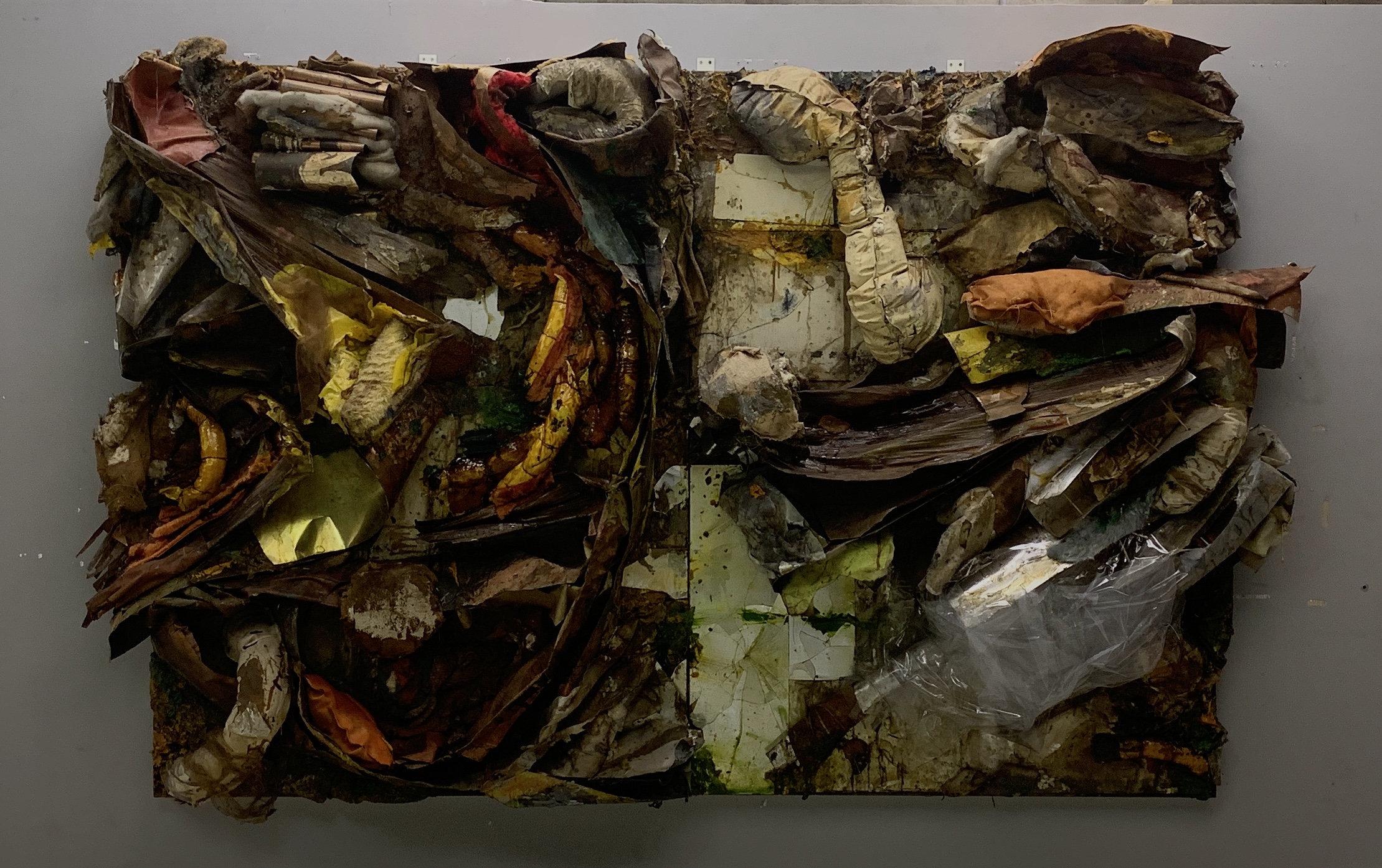
It is in Pera that is also the painting of the Brazilian artist Glauco Rodrigues (1929 – 2004), “Visão da Terra”, 1977, held during the military dictatorship, which presents a white man as a populist leader.
But it is in Buyukada that another of the highlights of the show is revealed, because it deals with a true history of local culture, the presence of american gay black writer James Baldwin (1924 – 1987) in Turkey, in the installation of Gleen Ligon.
Suffering prejudice in his country, Baldwin left the United States in the late 1940s and, in the 1960s, spent much of his time in Istanbul, then a welcoming place to cultural diversity. At the installation, Ligon exhibits Sedat Pakay’s 1970 film “From another place”, with testimonials from Baldwin, who is first seen there with Turkish subtitles.
In Buyukuda, four other works, including the installation of the collective Monster Chetwynd, in one of the island’s abandoned mansions, which looks like Halloween ornaments, but is somewhat adapted to the island’s decadent style. It was there that Trotsky lived exiled and his house, like so many others, seems in ruins.
“The seventh continent” is not the brightest edition of Istanbul, but by bringing a current and important theme, maintaining relationships with local history and occupying spaces beyond traditional ones, continues to remain as the most original events of the circuit.
lack, slave, African, sodomite, sorcerer, exile”, says Paulo Pascoal, the actor who plays José Francisco Pereira, kidnapped from the Republic of Benin to Pernambuco in the 18th century, and sold as a slave. There, he used syncretism as a means of survival. In 1731 Pereira was tried by the Lisbon Inquisition for sorcery and sodomy.
The speech in the scene of Carlos Motta’s Corpo Fechado: The Devil’s work in Vermelho Gallery summarizes the issues surrounding Brazil today, roots of fascist racism that polarize the country. Motta, however, goes deeper into the film, associating slavery with inquisition clearly through Letter 31 – The Book of Gomorrah, written in 1049 by St. Peter Damian, considered the first text of the Catholic Church to condemn homoerotic practices.
Corpo Fechado: The Devil’s work was performed and exhibited in Portugal last year in a sophisticated staging that blends beyond the story of Pereira and Letter 31, excerpts from Walter Benjamin’s Theses on the Concept of History (1892 – 1940 ), canonical text of the critique of the conventions of historicism. Next to the movie is the projection of the video “I mark my presence with my own beliefs”, where Paulo Pascoal is interviewed by Motta and tells of the difficulties he experienced when he assumed his homosexuality in his native Angola.
This kind of multiplied mirror, where the real story of the character in the film is reflected in the very story of the actor who plays him, is key to understanding the We, the Enemy, show that occupies the entire gallery, and looks more like an institutional show that in a commercial space.
In it, Motta creates a clear narrative where the works are pieces that, on the one hand, address the emergence of prejudice against homosexuality, at the same time create elements that, far from relying on a discourse of victimization, goes in reverse to generate affirmation of queer culture.
Already on the facade of Vermelho this is seen by the appropriation of the pink triangle, which in Nazism represented gay men condemned to death, becoming the work Ways of Freedom: Triangle, a mural with its own large image and a poster with a historical line, which narrates, since 1500, facts related to both prejudice and its opposite, as the determination, now in 2019 by the STF that transphobia and homophobia are crimes.
It is in propositions like this that artistic practices cease to be illustration on a theme, to become catalysts of experiences, generating new forms of representativeness, questioning established patterns.
1 de 2
Carlos Motta, "Formas da liberdade: Triângulo". FOTO: Edouard Fraipont
Carlos Motta, "Corpo fechado", 2019. FOTO: Edouard Fraipont
The whips displayed on the second floor of the gallery follow this same key, because if in the movie Corpo Fechado: The Devil’s work the whips are used as a form of martyrdom, in the series called Closed Body, they approach the fetish objects of gay culture. This hardcore scene, by the way, portrayed by Robert Mapplethorpe (1946 – 1989) in iconic images, as he inserts the whip into his anus, is appropriated by Motta, who re-enacts the 1978 photograph, darkening it, in a kind of context. of the show’s questions.
It is in the video We the enemy (2017), which gives title to the show, where the artist positions the central issue of the show. Created by the SPIT group! (Sodomite, Inverts, Perverts Together), composed by Motta, writer John Arthur Peetz and choreographer Carlos Maria Romero, the video is a compilation of dozens of derogatory and insulting terms, spoken by Greek artist Despina Zacharopoulos, as “perverts, bambi , dolls, pederasts, queues” with an emphatic conclusion: “we are and always will be the enemies ”.
Faith Ringgold, "American People Serie #20: Die", 1967.
*Por Gustavo Von Ha, em Nova York
Uma das primeiras instituições nos EUA dedicada exclusivamente à exposição de arte moderna, o Museu de Arte Moderna de Nova York (MoMA), surgiu no final dos anos 1920 idealizado, inicialmente, como um museu em constante mutação. Segundo palavras do próprio diretor fundador Alfred H. Barr Jr., “um torpedo se movendo no tempo-espaço com seu nariz avançando sempre a partir do presente e sua calda alcançando um passado recente de no máximo 100 anos atrás”. A ideia era que, à medida que a coleção do MoMA fosse envelhecendo, suas obras seriam recicladas, vendendo aquelas com mais de cinquenta anos para outros museus – como o Metropolitan e o Whitney – enquanto obras de artistas emergentes continuariam sendo compradas.
Desde 2014, o MoMA vem passando por um processo de expansão. Essa reforma vai muito além da nova “ala oeste” do museu: o antigo MoMA se fundiu de forma perfeita com os cerca de 14.000 metros quadrados extras. Andando pelo museu não se percebe mais onde começa e onde termina a parte nova. O valor real da expansão do “novo MoMA” é resgatar sua missão inicial, um espaço que permita repensar a coleção, transformando a experiência artística em pensamento crítico dentro do museu, e questionar a forma como essa coleção foi apresentada até hoje, descobrindo novas vozes e novas perspectivas.
1 de 5
Caderno de referências de Hudinilson Jr. Foto: Patricia Rousseaux
Obra de León Ferrari. Foto: Patricia Rousseaux
Obra de León Ferrari. Foto: Patricia Rousseaux.
Obra de Richard Serra. Foto: Patricia Rousseaux
Jac Leirner, Pulmão (Lung), 1987
O MoMA muitas vezes foi ousado na maneira de se posicionar ao inserir artistas americanos em narrativas mais amplas da história da arte. Exemplo disso é o caso de Jackson Pollock que durante décadas ficou na sala vizinha da de Monet, equiparando esses dois artistas como o ápice da história da arte e forçando uma leitura parcial ao projetar um artista estadunidense na história da arte mundial.
Se o “novo MoMA” é calcado na primeira ideia de sua fundação – menos formalista, talvez – deixa agora, por outro lado, lacunas entre obras confrontadas entre si, tirando a possibilidade de comparar de maneira sistemática o que foi produzido antes e depois. Ao mesmo tempo, o MoMA agora possibilita uma experiência mais livre, ao fazer e permitir novas conexões com obras do acervo em constante diálogo com novos trabalhos.
Em seu novo rearranjo, o museu coloca fotografias no mesmo patamar de pinturas permitindo olhar a coleção de outra forma. O que antes era mostrado sempre em núcleos isolados ou no subsolo, agora se mistura com pinturas, desenhos, gravuras e performances. Há filmes passando por toda a parte, mesmo nas galerias que ainda guardam as “obras primas” do modernismo.
1 de 5
Obra de Sheela Gowda. Foto: Patricia Rousseaux
Obra de Sol LeWitt. Foto: Patricia Rousseaux
Obra de Rasheed Araeen. Foto: Patricia Rousseaux
Obra de Wolf Vostell. Foto: Patricia Rousseaux
Rrivane Neuenschwander, "Work of Days", 1998
Ainda é possível contemplar um único trabalho em algumas galerias, mas com sua nova configuração o museu se abre radicalmente para ensaios ao vivo dentro do Marie-Josée e Henry Kravis Studio, onde sempre há algo inesperado acontecendo de tempos em tempos. É um espaço novo dedicado à performance e novas experiências de imagem em movimento, fundamental para inserir a coleção do MoMA em uma perspectiva histórica atual através de novos projetos e artistas emergentes.
Apesar da apresentação ainda ter um tom cronológico, ela traz ambiguidades, anacronismos e algumas surpresas. As galerias agora falam de ideias e épocas e não mais em categorias e vanguardas. A questão conceitual é o novo fio condutor, inaugurando um museu mais permeável e mais alinhado com o mundo de hoje.
Isto pode trazer duas questões: a própria transformação da historiografia da arte a respeito de como são pensadas suas metodologias e teorias; e a formação artística, pois a grande maioria das pessoas que acessa um museu hoje não tem formação de história da arte e está ali para uma experiência que transcende qualquer nomenclatura ou ficha técnica. Então como lidar com essa nova abordagem do público dentro de um museu? Como acessar esse novo ser humano disperso e ao mesmo tempo com o mundo inteiro à distância de um clique?
O público de hoje divide sua atenção entre as obras nas paredes e seus telefones. Hoje o mundo se apresenta através de imagens, a ideia de contemplação mudou radicalmente desde o surgimento dos smartphones. As chaves são outras, quase todo mundo tem familiaridade com as obras que estão no museu antes mesmo da experiência de estar diante delas; as obras que estão no museu estão também reproduzidas fora do museu, estão simultaneamente nos celulares, computadores, revistas e jornais. Além de textos críticos que reforçam a ideia da obra nos dando outras chaves de acesso. Quando finalmente temos a experiência real, é como um déjà vu, aquela estranha sensação de já ter vivenciado aquilo antes. São vários os mediadores nas relações entre o museu imaginário e o museu real.
Senga Nengudi, R.S.V.P.I., 1977-2003.
A coleção do MoMA tem mais de 200 mil peças e agora oferece também navegação e pesquisa digital, tornando possível acessar online imagens de cerca de 81 mil obras. Mesmo esse novo público que já está condicionado a ver tudo online pode notar cortes transversais nas associações das imagens expostas tanto no museu quanto no site do museu.
Numa lógica contemporânea ditada pelos algoritmos, o novo MoMA mudou também a sua lógica para rever a arte do século passado. Hoje é impossível olhar para um trabalho ignorando a realidade em seu entorno. Todas as pautas sociais, identitárias, de cor e gênero, estão também inevitavelmente conectadas a essas obras que agora podem ser lidas e ressignificadas no caminho de volta ao passado.
A partir disso, a instituição começa a substituir a ideia de “obra-prima” por um tipo de narrativa mais permeável, proporcionando leituras mais democráticas, onde cada um pode entrar com suas próprias chaves nas obras apresentadas, apesar de a entrada custar 25 dólares, exceto às sextas-feiras entre 17:30 e 21:00 quando as entradas são patrocinadas por uma empresa.
Está surgindo uma nova narrativa sobre a arte moderna com associações de trabalhos aparentemente improváveis. Por décadas os curadores do MoMA associaram trabalhos de Picasso a núcleos de cubistas, como Georges Braque, ou surrealistas em uma sala e abstração geométrica em outra sala. Agora a estratégia é usar conceitualmente algum trabalho e a partir dele agrupar na mesma galeria trabalhos de categorias diversas confrontados em um mesmo espaço. Isso era impensável até algumas décadas atrás, pois rompe com a narrativa (hegemônica) inventada pelo próprio museu e potencializa ainda mais a dispersão contemporânea embalada pelo público que nasce dessa lógica da rede. Isso contribui para a formação de futuras gerações dentro de uma dinâmica que se recusa a aceitar apenas uma versão da história. O MoMA está menos engessado, parece estar tentando se livrar das questões modernistas que ainda assombram todo o sistema de arte. Dessa forma parece também querer se redimir de uma narrativa autoritária que no passado utilizou a arte como arma política de disputa pela hegemonia global.
Escute trilha sonora para visitar
o museu “MoMAX” no Spotify
Na ocasião da conceitualização do Seminário Gestão Cultural: Desafios Contemporâneos, além dos palestrantes que somaram ao evento, fomos atrás de inúmeros profissionais que vêm trabalhando junto às dificuldades enfrentadas pela cultura no nosso país.
Aqui, uma entrevista com Lucimara Letelier, fundadora e diretora do Museu Vivo, consultoria de inovação e sustentabilidade econômica em museus e cultura, co-idealizadora do HiperMuseus. Ela atua há 20 anos em gestão cultural, social e de museus, com projetos com mais de 40 organizações, como Museu da Língua Portuguesa, Museu da Imigração, Museu Villa Lobos, Oi Futuro, Museu do Amanhã, MAR e Espaço BNDES. É mestre em Administração Cultural pela Boston University, foi diretora adjunta de Artes do British Council, diretora de captação da ActionAid. É conselheira no ICOM Brasil e ICOM MPR, ActionAid e ABGC.
ARTE!Brasileiros — Lucimara, como surgiu a ideia de criar a consultoria Museu Vivo? LUCIMARA LETELIER —Com 20 anos de atuação na área em Gestão Cultural, Gestão de Museus e Direitos Humanos, senti a necessidade de criar uma plataforma que sintetizasse um pouco de tudo que tinha observado com as dificuldades e aprendido no caminho. Nesse sentido, passei um ano e meio estudando o Programa da Unesco para líderes, agentes de mudança, voltado para a Agenda 20/30. Esse é um programa que tenta discutir sobre os limites planetários, quais são as causas mais urgentes, discussões a serviço de um processo de transição no mundo, mas de fato voltado para ambientalistas, empreendedores sociais, agentes de pactos sociais. Ao fazer o curso que eles propõem, o Gaia Education me chamou muito a atenção, que não houvesse nenhuma discussão em volta de agentes de mudança no setor cultural e de museus. Nesse momento decidi tentar ver como essas pautas poderiam conversar com a área museológica, cruzar conhecimento e trazer oxigênio para os museus, que estão morrendo. Tentando pensar soluções orgânicas.
Como se implementa isso na prática? Pesquisamos modelos de instituições e resolvemos criar uma plataforma que proponha soluções de sustentabilidade para a cultura. Montamos uma consultoria em rede que tenta lançar mão de várias áreas para criar essas soluções. Que novas habilidades, que novas linguagens são necessárias percorrer?
Sim, mas não lhes escapa que, na maioria das vezes, se trata de um problema econômico. Acho que você está trazendo uma situação limite, que é a ausência de política pública. Na nossa opinião, hoje tem que ter uma pizza mista, com diversificação de recursos. Durante muitos anos tivemos repasses diretos e indiretos, como Lei Rouanet ou o repasse que se faz às OS, que sempre deixam a instituição “esperando” e sem reação ou exigência de pensar em outras alternativas. Esse sistema, no Brasil, está falido. Eu acho que não houve uma mobilização pública, civil, que entenda que a sustentabilidade é um ato político.
O MAR, por exemplo, que passa por uma crise financeira importante, tem uma enorme capilaridade e uma enorme relação participativa. Mas achamos que não há uma verdadeira busca de como tornar campanhas de teor progressista em campanhas capazes de gerar recursos. Nós temos pessoas progressistas, essas pessoas têm que estar envolvidas ao ponto de se sentirem parte do lugar que está sendo sustentado.
Lucimara Letelier, fundadora do Museu Vivo.
Vocês já operacionalizaram esta ideia de alguma forma? Sim. Montamos uma parceria com a benfeitoria.com, uma plataforma de crowdfunding com experiência em campanhas de financiamento coletivo; a SITAWI — Finanças do Bem, que gerencia o fundo, e nós, que gerenciamos as propostas com o conhecimento da gestão cultural. As três — Museu Vivo, benfeitoria.com e SITAWI — são organizações que têm suas próprias expertises. Por outro lado, o BNDES tem uma linha de financiamento para campanhas de sustentabilidade de investimentos de até R$ 300 mil. Assim, nas campanhas de matchfunding, a cada R$ 1 que os cidadãos colocam, o BNDES coloca mais R$2. Nesta linha, já criamos, por exemplo, duas campanhas: uma para o Museu do Inconsciente e outra para o Museu Bispo do Rosário, que envolvem a preservação das obras e restauros.
Como parte do projeto, a instituição, depois, recebe uma consultoria para trabalhar com o mailing que foi produzido nessa iniciativa. Uma coisa é um doador chegar para uma campanha, outra é o que fazer com seus dados. Na verdade, ele se torna um ente econômico. Na bilheteria, você apenas “vende um evento, uma atividade”. Nesta proposta, as pessoas “compram uma ideia”. E poder reter seus dados colabora com a possibilidade de continuar lhe oferendo serviços de apoio à instituição.
As pessoas no crowdfunding deixam o dinheiro para uma campanha, na bilheteria deixam o dinheiro para um evento, para uma atividade. É diferente, porque no primeiro caso está entregando um dinheiro para uma causa que quer apoiar. Na bilheteria, é apenas um custo. No Children’s Museum, onde trabalhei, eles consideram muito fortemente a pessoa que entra no museu como um ente econômico. Quando você entra para comprar um ingresso, assim como uma telecom, criam uma relação econômica com essa pessoa. Acho que seria importantíssimo que as empresas de tecnologia, por exemplo, além de pagar patrocínios, fossem capazes de oferecer know–how para os museus.
Sobre o título do nosso seminário, como você sintetizaria esses desafios? A instituição se entender como causa; ter uma escuta para seus problemas como de co-curadoria; trabalhar a conexão cultural casada com políticas públicas e privadas, trazer o conhecimento de cultura empreendedora nos gestores.
Gestão em tempos de tragédias
Diretora-executiva de Inhotim desde o último abril, Renata Bittencourt chegou ao instituto três meses depois do rompimento da Barragem do Feijão, na cidade de Brumadinho. Anteriormente, dentre outras coisas, ela havia sido diretora de Processos Museais do Instituto Brasileiro de Museus (IBRAM), de 2017 a 2019, e secretária da Cidadania e da Diversidade Cultural em 2016, ambos no extinto Ministério da Cultura (MinC). Ela é mestra e doutora em História da Arte pela Universidade Estadual de Campinas (Unicamp), graduada em Comunicação Social pela Escola Superior de Propaganda e Marketing (ESPM). Renata se especializou em Estudos de Museus de Arte e Gestão de Processos de Comunicação e Cultura pela Universidade de São Paulo (USP).
Renata Bittencourt, diretora executiva de Inhotim. FOTO: William Gomes
A lama da tragédia humana e ambiental não chegou ao grande museu a céu aberto, mas afetou o funcionamento de várias formas. Em entrevista ao site da ARTE!Brasileiros em junho deste ano, Renata afirmou que alguns de seus principais objetivos ao chegar em Inhotim era estimular a volta de visitação e estreitar laços com a comunidade local. Após o ocorrido em Brumadinho, o instituto assumiu um papel de compromisso social importante na vida da cidade, ação que a diretora conhece bem, pois entre 1997 e 1998 foi bolsista da organização Fulbright para observação de programas voltados a essa esfera: “Um desafio que acho importante ressaltar, que é importante para Inhotim em específico, mas acho que é para muitos outros espaços também, é o desafio da conexão com os territórios onde as instituições estão inseridos”, ela comenta.
No contexto da chegada de Renata ao instituto, foi iniciada uma nova fase do programa Nosso Inhotim, que cadastrou até agora aproximadamente 1500 moradores do município de Brumadinho para entrada gratuita na instituição e 50% de desconto nas atividades que ocorrem no espaço. Antes, os moradores tinham apenas o direito à meia-entrada. “Existe um desejo e uma ação nossa para uma reconexão ainda mais forte, uma criação de vínculo ainda mais forte com a cidade”. Ela ressalta que isso envolve desde os artistas até o reforço de ligações com as escolas da região e um alcance aos moradores de modo geral, sendo assim uma via de troca, onde a instituição abre suas portas e a cidade realiza um gesto de dizer aquilo que é interessante para Brumadinho: “Essa abertura para o território hoje ajuda a definir o que Inhotim é”.
Para a diretora, uma das principais situações ao chegar em Inhotim foi ver com ainda mais nitidez o fato de instituições serem feitas por pessoas. “Inhotim viveu essa tragédia muito na pele porque a pele de Inhotim é feita dessas 600 pessoas que trabalham aqui”, diz. Ela conta que a ideia de que uma gestão precisa, em todas suas esferas e decisões, ser humanizada foi uma reflexão provocada por esse acontecimento.
Decolonizando a gestão
Dentro da esfera de gestão de instituições culturais públicas e privadas no país, é importante ressaltar que Renata Bittencourt é uma das únicas pessoas negras à frente de uma instituição de grande importância no país. O fato está relacionado a um racismo institucional infelizmente ainda muito arraigado na sociedade brasileira. Renata destaca que é importante que sua posição neste momento sirva para criar uma interlocução nesse aspecto e ressalta pessoas como Rosana Paulino, Renata Felinto, Janaina Barros, Amanda Carneiro e Hélio Menezes, que não necessariamente atuam como gestores mas têm voz ativa no meio artístico: “A mim me dá uma impressão de que há caminhos que se abrem”.
Claudinei Roberto da Silva, professor e curador independente. FOTO: Antonio Trivelin.
Neste ponto, o curador, artista plástico e professor Claudinei Roberto da Silva afirma que o que se pode “perceber é aquilo que é fácil de ser constatado: existe uma competência negro-brasileira que foi historicamente negligenciada”. Ele é formado em Artes Plásticas pela Escola de Comunicação e Artes da Universidade de São Paulo (USP), ex-coordenador do Núcleo de Educação do Museu Afro Brasil, além de atuar como curador independente e professor de desenho, pintura e História da Arte em instituições pelo país. Ele ressalta que a preocupação em incluir essa competência hoje existe, mas em uma proporção que poderia ser maior. Ele destaca a falta de pessoas negras em cargos de gerência em instituições pelo país e afirma: “A instituição não é decolonial porque promove simpósio de diáspora afro-atlântica, ela vai ser decolonial quando tiver negros, negras e indígenas em cargos de diretoria”.
De acordo com Claudinei, não existe a possibilidade de se falar de decolonialismo sem trabalhar antes a ideia de anticolonialismo: “Fica muito difícil tratar de decolonialismo sem falar de hegemonia, sem falar de hegemonia cultural e de branquitude. As pessoas precisam reconhecer o atraso delas nesse momento da História”. Suas observações são a partir do que ele enxerga em São Paulo. Ele aponta a extrema importância de se fazer um esforço para trazer à tona uma história, registrá-la em livros, em catálogos ou em documentos “extraordinariamente bem realizados”, mas que nada é mais fundamental do que observar se no corpo de funcionários de instituições museais a presença negra está contemplada.
Diagnosticado como esquizofrênico paranoico, Arthur Bispo do Rosário viveu por quase 50 anos, entre entradas e saídas, como interno de hospitais psiquiátricos do Rio de Janeiro. Aproveitou-se dos materiais precários que o cercavam para recriar o mundo em uma obra inestimável. A partir dos fios dos seus próprios uniformes, criou mantos e tecidos. Concebeu também esculturas e murais cobertos de objetos que colecionava compulsivamente, montando todo um universo paralelo.
Falecido em julho de 1989, o artista tem tido sua obra revisitada, restaurada, higienizada e catalogada desde o fim de 2016. Em setembro de 2019, o acervo de Bispo do Rosário foi tombado pelo Instituto do Patrimônio Histórico e Artístico Nacional (Iphan), em decisão unânime de seu conselho consultivo.
Com patrocínio da Fundação Marcos Amaro (FMA), o Museu Bispo do Rosário Arte Contemporânea, no Rio de Janeiro, vai incorporar ao seu atual espaço, onde funciona hoje a área expositiva e o acervo em restauro, um dos pavilhões da antiga Colônia Juliano Moreira, hospitalonde o artista viveu por muitos anos. A edificação, que terá que ser totalmente restaurada, abriga a cela ocupada por Bispo, que a encarava como uma espécie de ateliê.
1 de 4
Imagens do pavilhão e das paredes da cela. Fotos por Patricia Rousseaux.
“As paredes da cela onde viveu Bispo do Rosário estão completamente tomadas por desenhos que foram cobertos por camadas de tinta ao longo dos anos. Vamos retirá-las pouco a pouco, em um processo de restauração da camada original de tinta, na tentativa de revelar todo o universo criativo do Bispo impresso naquelas paredes”, afirma Ricardo Resende, curador do Museu e também da FMA. Depois de restaurada, a cela funcionará como espaço expositivo permanente para as obras do artista sergipano. “A ideia é justamente apresentar ao público seus trabalhos em sua ambiência natural, onde foi criada – até mesmo porque a obra do Bispo ganha sentido, significado e potência de proporções imensuráveis quando contextualizada naquela paisagem do manicômio”, comenta.
Para o início do projeto de restauração do pavilhão, a Fundação Marcos Amaro doou à instituição carioca o montante de R$ 350 mil. Em 2017, a fundação apoiou a readequação e renovação da atual reserva técnica do Museu. No início de 2018, os incentivos foram para a readequação das atuais salas expositivas, garantindo melhores condições museológicas de exibição para a obra. “Com esse apoio, a FMA reafirma o seu propósito em não somente impulsionar a produção contemporânea com criação de prêmios e residências voltados a jovens artistas e em atividade, mas também pela preservação e conservação da arte contemporânea brasileira”, afirma Raquel Fayad, diretora geral da fundação.
1 de 5
Obra na exposição UTOPIAS.
Odete, artista paciente do ateliê do museu, foi retratada em obra de Pola Fernandez.
O "Veleiro" de Bispo do Rosário.
Obra de Bispo na Reserva técnica.
“Esse procedimento é o maior já realizado em obras de arte contemporânea no Brasil. O método consiste na retirada do oxigênio de estrutura construída justamente para este fim, uma bolha hermeticamente fechada, onde foi acomodada em sua primeira etapa a metade da obra de Bispo do Rosário. De lá, através de um mecanismo, foi retirado de seu interior todo o oxigênio deixando apenas o hidrogênio”, explica Ricardo Resende. “Esse processo garante uma eficaz eliminação de cupins, fungos ou qualquer outro microrganismo por asfixia. Trata-se de uma tecnologia que não afeta a obra, que é extremamente frágil, e requer o máximo de cuidado.”
Atualmente, está em exibição na sede do Museu a mostra UTOPIAS: A vida para todos os tempos e glória, contemplada no Edital do Produtor Cultural de 2018 – ISS, que dá continuidade à proposta do Museu de garantia e ampliação do acesso à arte e à cultura fora dos eixos convencionais da cidade. Com curadoria de Diana Kolker e Ricardo Resende, a exposição apresenta obras de artistas integrantes do Atelier Gaia, vinculados ao Museu Bispo do Rosário, e das obras desenvolvidas pelas artistas Pola Fernandez, Val Souza, Ercilia Stanciany, Veridiana Zurita e Seu Hernandes José da Silva, convidados a participar do programa de residência Casa B.
O trabalho de Pola Fernandez foi também exibido na ocasião da abertura da exposição Bispo do Rosário: As Coisas do Mundo, aberta na Fábrica de Arte Marcos Amaro – FAMA, em Itu, no mês de setembro.
Sempre Gay: meninas de azul e meninos de rosa aborda conceitual e artisticamente a resistência de jovens artistas diante de situações de ódio, discriminação e apagamentos. Organizada pela Transarte, galeria voltada a projetos com temática LGBTQ e à arte transgressora, a exposição reúne Liz Under, Bia Leite, Eduardo Mafea e Pedro Stephan, com trabalhos de pura militância.
A arte contemporânea desenvolveu uma estratégia de aproximação com o cotidiano. A narrativa de todos eles não separa a arte da vida, e a contrassenha para a sobrevivência é manter-se em estado de alerta permanente diante de uma sociedade violenta para gays, mulheres, negros, indígenas e pobres. Os trabalhos nascem espontaneamente, sem se preocupar com a fatura, e a maioria deles espelha situações vivenciadas. Liz Under, 24 anos, abre a exposição com fotos de uma performance com lençóis vermelhos com fendas vaginais, realizada em seu estúdio em Salvador, onde morava e trabalhava. O ensaio protagonizado por ela coloca o espectador como voyeur de uma imersão sensual. Liz vive em Araraquara e nos três anos que passou em Salvador estudou e começou na arte fazendo grafites pelas ruas e cartazes lambe-lambe. Foi lá que experimentou na pele o desafio de fazer uma arte transgressora. “Mesmo dentro do Museu de Arte Moderna, onde fiz curso de litografia, não escapei de uma sociedade opressora”. Sua aversão pelo mundo machista inspirou um desenho com a imagem de um gato com um pênis atravessado na boca, que irritou seus colegas de curso. “Começaram a me tratar mal, a chamar o gato de Miserável. A pressão era tal que eu chegava a me vestir de homem para conseguir me impor naquele ambiente machista e discriminatório”. Liz também sofreu com as gravuras de suas musas emparedadas. “Na história da arte os homens pintam mulheres nuas para deleite masculino e eu coloco minhas musas no papel na busca da construção do seu próprio prazer, do seu próprio afeto”. Quando Liz expôs esses trabalhos na 5ª Bienal de Gravura Lívio Abramo, em Araraquara, foi agredida moralmente por um jornalista local, conhecido pelo seu sobrenome, Madalena. “Revoltado, ele me ofendeu e classificou meu trabalho como ‘arte vadia’. Eu adorei o nome, nem precisei pensar em outro título, fiquei com o dele”. Ela lembra que hoje no Brasil temos a legitimação da violência que vem de quem está no poder. A artista fala de uma necropolítica instalada com poder social e político para decidir quem vive e quem morre. “Os alvos preferidos são os LGBTQ, pessoas negras e pobres”.
Bia Beite, série Naoparanao
Assim como a obra de Liz é considerada inadequada socialmente por uma classe conservadora, o trabalho de Bia Leite também provoca insultos. Ela ganhou as páginas do noticiário quando sua pintura Criança Viada foi censurada na exposição Queermuseu no Centro Cultural Santander de Porto Alegre. Sob protestos de alguns visitantes a exposição foi fechada e ela perseguida e ameaçada de morte. A mostra só foi liberada depois de criado um programa de arrecadação promovido pelo Parque Lage, no Rio de Janeiro, onde a mostra foi exposta com filas homéricas. A pintura que horrorizou os gaúchos traz impressos vários xingamentos preconceituosos sofridos pelos homossexuais desde a infância. Bia foi descoberta e premiada pelo Edital Transarte LGBT, em 2015 e agora acaba de firmar um contrato de exclusividade com a galeria, onde expõe nesta mostra pinturas inspiradas em alienígenas e em um poster japonês de filme de terror, do diretor John Carpenter. Sua pintura lembra os traços neoexpressionistas da década de 80, com cores corrosivas e citações do universo pop.
Sob influência também expressionista, Eduardo Mafea defende seu trabalho como mergulho no dualismo do homem gay e a ligação compulsória ao universo machista do futebol, esporte apreciado pelas famílias como símbolo de virilidade. Com outras preocupações, Pedro Stephan, apaixonado pelo Rio de Janeiro, autor de tetos homoeróticas, mostra pela primeira vez o ensaio Lâmpadas de Mercúrio, que pode ser visto como uma fotonovela não narrativa tendo como cenário o Parque do Flamengo, local carioca onde vive desde a infância quando passeava por lá de bicicleta. As 30 imagens do ensaio mostram amigos de Stephan clicados em 2005 em cenas amorosas. “Tentei subverter o clichê provando que a pegação não é só sacanagem, pode ser também romance”.
A diretora da Transarte, Maria Helena Peres escreve em um de seus catálogos que precisamos estar atentos ao Brasil que vem propondo a cura gay, que fecha exposições, bate e mata travestis e cria monstros dentro dos integrantes do movimento LGBTQ.